
“GEGHARD”
SCIENTIFIC ANALYTICAL
FOUNDATION


2026
2026
2026-03-16
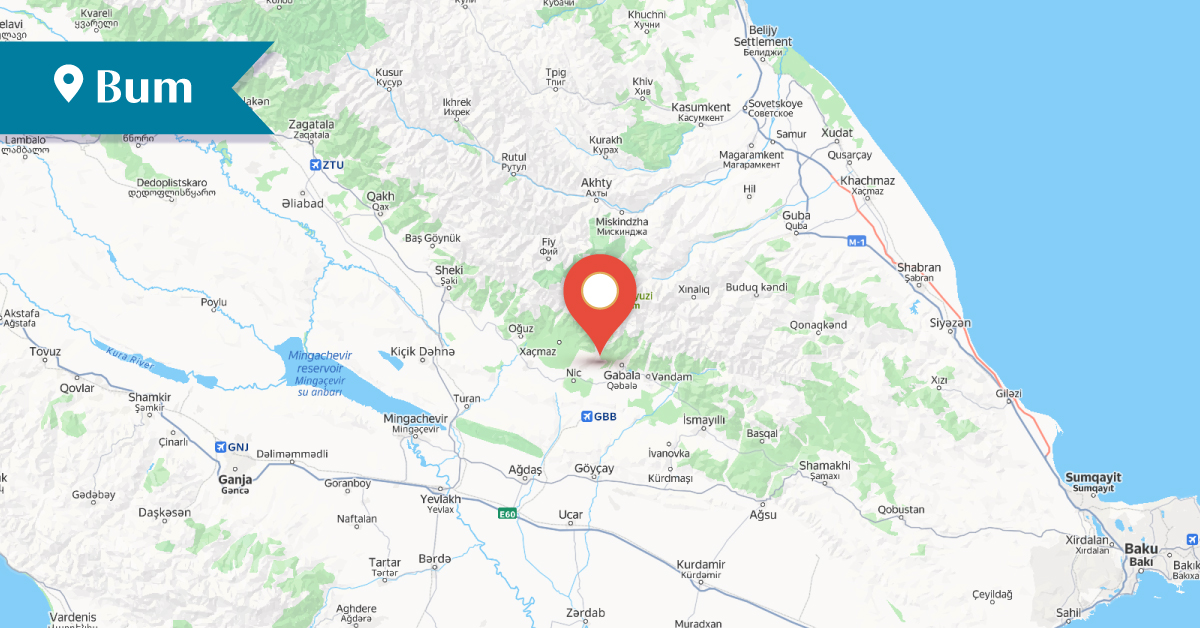
The settlement of Bum is located in the Kutkashen (Gabala) district of Eastern Transcaucasia, 6.7 km northwest of the district center of the same name. The village was also known as Boyin and Bomen. It is likely that the settlement of Bum corresponds to Homenk, mentioned in the work of the 7th-century Armenian historian Movses Kaghankatvatsi. From this, it can be inferred that the settlement has existed since at least the Early Middle Ages. According to the historian’s account, Apostle Yeghishe, who is regarded as the first preacher of Christianity in Caucasian Albania, was martyred near Bum. The site was later sanctified by the local inhabitants. According to tradition, the Armenian king Vachagan the Pious (r. 485–510) transferred the relics of the apostle to Artsakh, to the monastery of Jrvshtik, also known as the Monastery of St. Apostle Yeghishe (located in the Martakert district of Artsakh). At the place of Apostle Yeghishe’s martyrdom, near the pit, King Vachagan later erected a pillar. According to accounts, a chapel also once stood there.
Philipos Pumetsi (Bumetsi), Catholicos of Aghvank (Caucasian Albania), who is mentioned in 1563, was also a native of this settlement. The lack of sources does not allow for a complete reconstruction of the village’s history. However, it is known that in the 18th century the village was still inhabited by Armenians. On October 28, 1725, the people of Bum, together with the people of other Armenian villages of the province, sent a letter to the Russian Emperor Peter I, requesting help. On behalf of the people of Bum, the letter was signed by Ter Minas, a priest, and a man named Payram. Following these events, in the mid-18th century the Armenian population of Bum was compelled to convert to Islam. As the inhabitants of Bum themselves noted, in the initial stage the new religion did not exert a strong influence on them, emphasizing the idea that “…during the day we act as Turks, at night we remain Armenians.” Even after adopting Islam, every year on May 8 the people of Bum made a pilgrimage to the site of the martyrdom of St. Yeghishe. Over time, however, the Armenians of Bum became detached from the Armenian milieu and gradually forgot the Armenian language, speaking instead one of the local Turkic dialects.
By the late 19th century, the inhabitants of Bum still retained memories of their Armenian origin. In 1889, a correspondent of the newspaper Nor-Dar, writing about the people of Bum, noted that they “...recount and affirm their Armenian identity, the oppression of the khans, the ways in which they were forced to convert to another faith, and so on...”. During that period, many inhabitants of Bum continued to bear Armenian personal names. At the end of the 19th century, the ruins of Armenian churches were still preserved in the village, and Armenian tombstones could be found in the Armenian cemeteries. Remains of a fortress were also preserved in the vicinity of the village.
In the following decades, however, Bum gradually and definitively lost its Armenian character.
Today the village still bears the name Bum and is mainly inhabited by Azerbaijanis.
Bibliography
Barkhutaryants, M. The Land of Aghvank and Its Neighbors. Artsakh. Yerevan, 1999, p․ 131, 132, 147, 148.
Banasirakan, Materials concerning the Utians. A. Anun. “Meghu Hayastani,” 1881, no. 69, April 25, pp. 1–2.
Banasirakan, Materials concerning the Utians. A. Anun. “Meghu Hayastani,” 1881, no. 73, April 30, p. 1.
Banasirakan, Materials concerning the Utians. A. Anun. “Meghu Hayastani,” 1881, no. 123, July 1, p. 1.
D. K., Correspondence, “Nor-Dar,” 1888, no. 62, April 20, p. 3.
T. P., Correspondence, “Nor-Dar,” 1889, no. 145, September 2, p. 2.
Karapetyan, S. Armenian Inscriptions of Proper Aghvank, Book I. Yerevan: NAS RA “Gitutyun” Publishing House, 1997, p․ 39.
Karapetyan, S. Aghvank Proper, Research on Armenian Architecture Foundation, 2024, Book 22, Part 1, pp. 252-254.
Shakili, Correspondence, “Nor-Dar,” 1897, no. 81, May 20, p. 3.
Ruhani, On the Occasion of Khudadean’s Testament, “Nor-Dar,” 1899, no. 46, March 13, p. 2.
Kamaleants, S., About Udi Festivals [From a Notebook]), “Ardzagank,” 1894, no. 53, May 11, p. 2.