
“GEGHARD”
SCIENTIFIC ANALYTICAL
FOUNDATION


2026
2026
2026-01-29
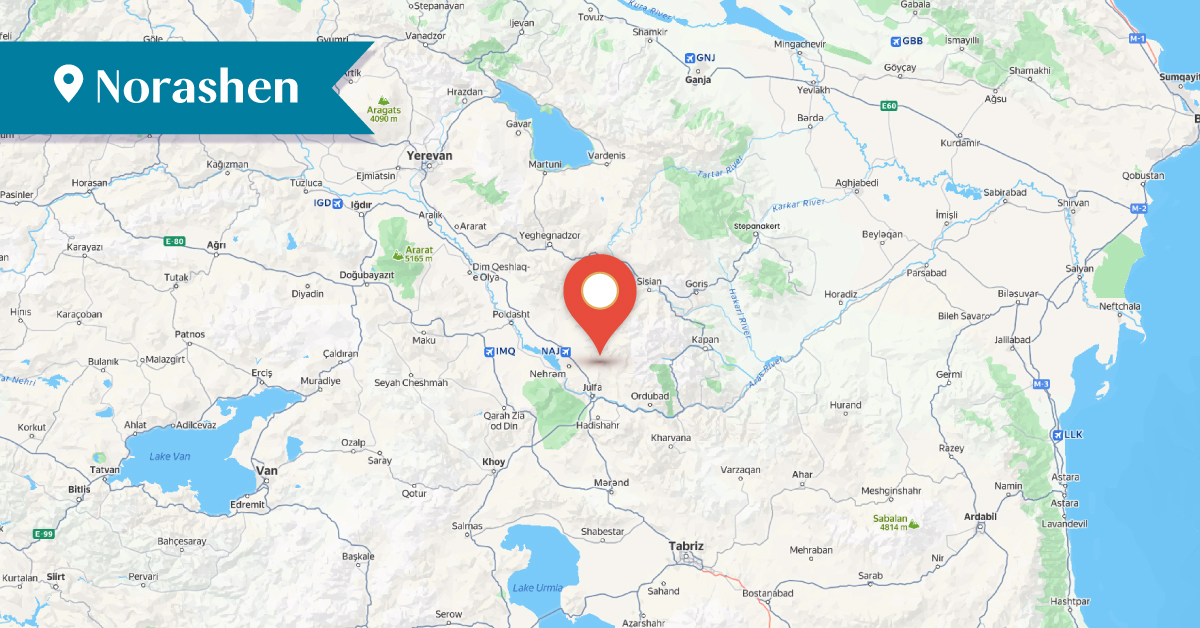
Norashen was one of the notable Armenian villages of the Yernjak district of the Syunik province of historical Armenia. The village was located on the right bank of the Yernjak River, opposite the fortress of the same name.
According to the prominent 13th-century Armenian historian Stepanos Orbelyan, the village was called Norakert and paid a tax of 12 dahekans to the Tatev Monastery.[1] In historical sources, the village was named Norakert from the 10th to the 14th centuries; from the 15th century onward, it was known as Norashen and Norashenik, while a 19th-century tombstone inscription records the name Noragyugh.[2] In a Gospel manuscript copied at Sevan Monastery, the village is mentioned as Norashinik.[3]
In ancient and medieval periods, the village was inhabited by Armenians, while in modern times Muslims also lived there. Having a large population, in the 17th–18th centuries this settlement was mentioned as a town.[4]
As of 1914, Armenians and Islamized Armenian Catholics lived in the village.[5]
Norashen was known for its churches of Surb Astvatsatsin (Holy Mother of God), Surb Grigor, Surb Hovhannes, and Surb Stepanos, the “Kusanats” or Surb Hripsime chapel, a bridge, a cemetery, and other monuments.
The Church of Surb Grigor was built in the medieval period and functioned until the mid-16th century. It is mentioned in a Gospel manuscript copied in 1357, in which the village is mentioned as Norakert.[6]
The Church of Surb Hovhannes (St. John) stood on the northwestern side of the village. Built in the 12th–13th centuries, the church had its entrance on the western facade. The church had no wall paintings or sculptural decorations. By 1870, it was in a semi-ruined condition.[7] Today, it is completely destroyed.
The Church of Surb Stepanos (St. Stephen) was constructed within the village territory in the medieval period. Its first recorded mention dates to 1660.[8] Currently, the church is in ruins.
The prominent Church of Surb Astvatsatsin (Holy Mother of God), founded in 951 was located in the central part of Norashen. It is a three-nave basilica with entrances on the western and southern sides. The narthex, which was built in the 17th century, had sculptural reliefs, while ornamental carvings around the entrances have been preserved. Inscriptions are found on several facades of the church. The Church of Surb Astvatsatsin was renovated several times during the 16th and 17th centuries. The first renovation took place in 1572. In 1663, the church was restored by the Norashen-born brothers Khoja Hanes and Mkrtich. Another phase of renovation is recorded between 1692 and 1695.[9] In the early 1990s, the church was still standing.
This Armenian settlement was a notable center of manuscript production; in the Church of Surb Astvatsatsin, numerous handwritten manuscripts were created in the second half of the 17th century.[10]
Opposite the village, on the Yernjak River, stood a bridge built in 1663, commissioned by the same khojas, Hanes and Mkrtich. The bridge was destroyed by a flood in 1871.[11] Remains of the ruined structure were still visible until the 1930s.[12]
On the summit of “Bolu Mountain” stood the “Kusanats” or Surb Hripsime Chapel, built in the 14th–15th centuries.[13] It was renovated in the 17th and 19th centuries. Around the chapel ther are 17th-century khachkars (cross-stones) without inscriptions. Today, the chapel is in ruins.
To the west of Norashen village lies a cemetery dating from the 15th to the 20th centuries. About 800–850 gravestones have been preserved here, with 124–130 bearing inscriptions.[14] By the 1980s, most of the inscriptions had been eroded or damaged.
Currently, the village is located in the Julfa District of the Nakhijevan Autonomous Republic, is populated by Azerbaijanis, and is called Goydara.[15]
Bibliography
Ghevond Alishan, Sisakan, Venice, 1893.
Stepanos Orbelian, History of Syunik, Yerevan, 1986.
L. Khachikyan, Colophons of Armenian Manuscripts, 14th Century, Yerevan, 1950.
T. Kh. Hakobyan, St. T. Melik-Bakhshyan, H. Kh. Barseghyan, Dictionary of Toponyms of Armenia and Adjacent Regions, Vol. 4, Yerevan, 1998.
A. Ayvazyan, The Armenian Monuments of the Nakhijevan ASSR: A Comprehensive List, Yerevan, 1986.
A. Ayvazyan, The Monumental Memorials and Relief Carvings of Nakhijevan, Yerevan, 1987.
A. Ayvazyan, Architectural Monuments of Norashen, Lraber, 1980, no. 8.
Nakhijevan Atlas, Research on Armenian Architecture Foundation, Yerevan, 2012.
[1] Stepanos Orbelian, History of Syunik, Yerevan, 1986, p. 403.
[2] A. Ayvazyan, The Armenian Monuments of the Nakhijevan ASSR: A Comprehensive List, Yerevan, 1986, p. 73.
[3] Dictionary of Toponyms of Armenia and Adjacent Regions, Vol. 4, list 1, Yerevan, 1998, p. 21.
[4] Ibid., pp. 19-20.
[5] Nakhijevan Atlas, Research on Armenian Architecture Foundation, Yerevan, 2012, p. 21.
[6] L. Khachikyan, Colophons of Armenian Manuscripts, 14th Century, Yerevan, 1950, p. 424.
[7] Nakhijevan Atlas, Research on Armenian Architecture Foundation, Yerevan, 2012, p. 24.
[8] Ibid.
[9] A. Ayvazyan, The Armenian Monuments of the Nakhijevan ASSR: A Comprehensive List, Yerevan, 1986, pp. 74-75
[10] Ibid., p. 22.
[11] Ghevond Alishan, Sisakan, Venice, 1893, p. 367.
[12] A. Ayvazyan, Architectural Monuments of Norashen, Lraber, 1980, no. 8, p. 115.
[13] Ghevond Alishan, Sisakan, Venice, 1893, p. 368.
[14] A. Ayvazyan, The Armenian Monuments of the Nakhijevan ASSR: A Comprehensive List, Yerevan, 1986, p. 79
[15] Azerbaijani - Göydərə. Göy means blue or sky, dərə-gorge.