
“GEGHARD”
SCIENTIFIC ANALYTICAL
FOUNDATION


2026
2026
2026-01-19
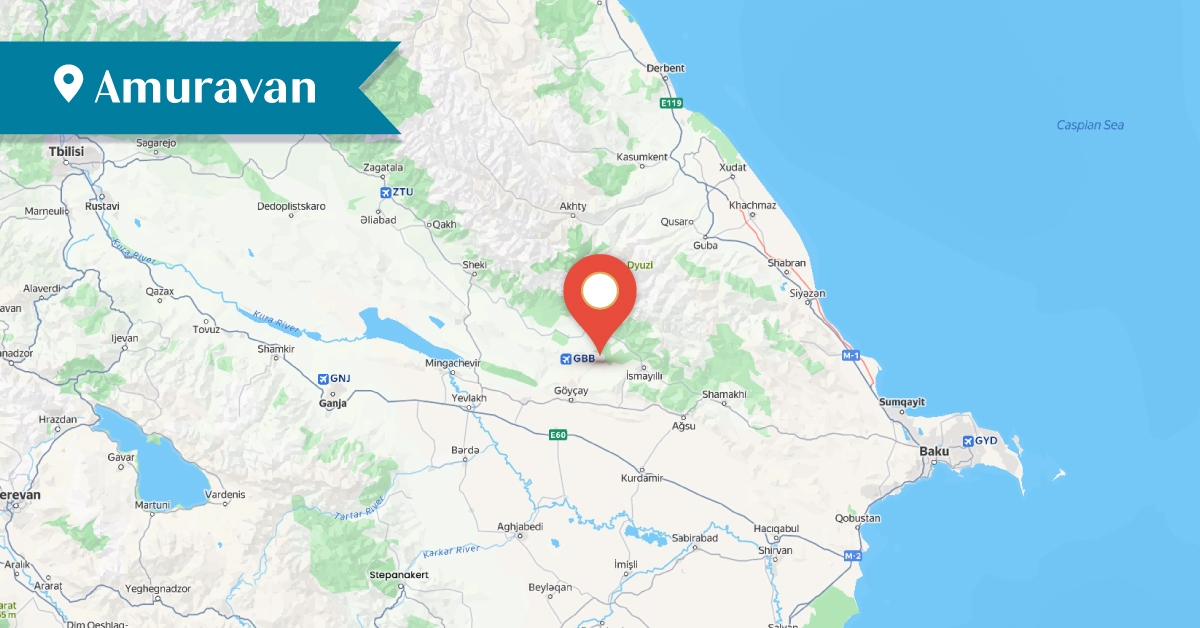
The settlement of Amuravan is located in the Kapaghak district of historical Caucasian Albania, 17.3 km southeast of the present-day administrative center of Gabala (Kutkashen). The village has also been recorded as Amiravan, Amirvan, and Amrvan.
The earliest references to the settlement date back to the 19th century. In 1841, the village had 617 Armenian inhabitants; in 1851, 438; and in 1876, 992. According to data from 1886, the population was1,012, while in 1914 it reached 1,174 Armenian inhabitants. According to the newspaper Nor-Dar, many residents of the village died from smallpox in 1888. It is also known that before 1870, part of the population of Amuravan left the village and founded a new settlement called Gharasun, located 2.8 km northeast of Amuravan.
Through the efforts of the villagers and with the support of the Baku Philanthropic Society, a school was opened in the village in 1882. It was named Gevorgyan, after the village church. In the 1886–1887 academic year, the school was staffed by a teacher named Hovhannisyants, and the number of pupils ranged between 38 and 40. In the 1888–1889 academic year, 23 students were enrolled, while in 1889–1890 the number rose to 42. In 1895, the school was closed by the Tsarist authorities. Information about the reopened school has been preserved from 1908, when it had one teacher and 53 students. In 1914, the school was closed again.
In Amuravan stood the Church of St. Gevorg (St. George), which has been mentioned since 1832. In 1887, the church was recorded under the name Holy Savior (Surb Amenaprkich). In 1891, the church was renovated through the efforts of the inhabitants of Amuravan. Samvel Karapetyan noted that in 1984, an inscription describing the church’s renovation was still preserved above the southern entrance of the building. The inscription reads:
The Church of the Holy Savior (Surb Amenaprkich) was renovated in 1891 with funds provided by the ecclesiastical community of Amuravan, during the period of service of Priest Father Harutyun Harutyunyan.
Among the priests of the church were Mikayel Avtandilyan Margaryants, who served until 1868; Galust Ter-Sargsyants, mentioned in 1868; Harutyun Hakobyan-Harutyunyants and Nerses Voskanyants, mentioned in 1910. In 1917, the village priest was Yeghishe Ter-Hovsepyan. Administratively, the village belonged to the Artsakh Diocese of the Armenian Apostolic Church.
In the Armenian cemetery located in the southern part of the village, about 200 rectangular, carved, inscribed tombstones, dating from the 18th to the 20th centuries, were still preserved in 1984. The oldest tombstone is dated 1786, which suggests that the Armenian settlement existed at least from the second half of the 18th century. The Armenian inscription on this tombstone read:
This is the grave of Bakverdi, son of Gharakat, 1786.
To the north and northeast of Amuravan, traces of two medieval village sites, Paravi Bagh and Uzukh, have been preserved. These sites contained ruins of churches and Armenian cemeteries, indicating that Armenian settlements once existed in those locations. The sites were studied in the late 1880s by Bishop Makar Barkhutaryants, who published four of the inscribed tombstones found in the cemetery of Paravi Bagh. During Samvel Karapetyan’s visit in 1984, only one inscribed tombstone remained preserved, bearing the following inscription:
Year 1466. May God have mercy on Lord Ovanes/Hovhannes , who was a very kind man.
On the eastern edge of the tombstone, a khachkar bearing an Armenian inscription had been erected in his memory. Later, the Azerbaijani researcher F. Nagiyev, by falsifying the inscription on the tombstone, presented it in his work as Albanian and re-dated it.
At the same site, other tombstones and khachkars dating to the 15th century, bearing Armenian inscriptions, were also discovered in 1984.
In the cemetery of the Uzukh site, Bishop Makar Barkhutaryants copied and published seven Armenian inscriptions, which, however, had not survived by 1984. In that same year, Samvel Karapetyan discovered a khachkar of distinctive design, bearing the following Armenian inscription on its upper section: In the year 1556, Chunshib.
In 1917, following the Russian Revolution, the collapse of authority in Eastern Transcaucasia left Armenian settlements exposed to attacks by Turkic-Muslim armed bands. The situation deteriorated further with the advance of Ottoman forces into the region. Like many other Armenian villages in the area, Amuravan was devastated, and a significant portion of its population was killed. After the establishment of Soviet rule, the surviving inhabitants of Amuravan returned to their village and rebuilt it. However, as a result of the anti-Armenian policies of Soviet Azerbaijan, many residents were forced to leave the village. At the same time, Azerbaijanis were settled there. By 1985, only 12 Armenian households remained in Amuravan, and on December 1, 1988, they were forcibly compelled to leave the village.
Bibliography
Amirvan Village, Nor-Dar, 1885, no. 185, 1 November, pp. 2–3.
From Amirvan, Nor-Dar, 1888, no. 194, 18 November, p. 2.
From the Village of Amirvan, Nor-Dar, 1888, no. 219, 28 December, p. 2.
Barkhutaryants, M. The Land of Aghvank and Its Neighbors. Artsakh. Yerevan, 1999, pp. 112–113.
Khoi-Zadeh, Nor-Dar, 1895, no. 223, 19 December, p. 2.
Karapetyan, S. Armenian Inscriptions of Proper Aghvank, Book I. Yerevan: NAS RA “Gitutyun” Publishing House, 1997, pp. 35–38.
Karapetyan, S. Aghvank Proper. Research on Armenian Architecture Foundation, 2024, Book II, Part 1, pp. 235–247.
Martiroseants, G. Amruan, Nor-Dar, 1891, no. 62, 12 April, pp. 2–3.
Syunetsi. Amirvan, Nor-Dar, 1887, no. 86, 3 June, p. 2.
Ter-Hovsepyan, Yegh. Amirvan, Horizon, 1917, no. 177, 20 August, pp. 3–4.
Nagiyev, F. “New Albanian Scripts and Their Decipherment,” Proceedings of DSPU, no. 2, 2009, pp. 100–101.