
“GEGHARD”
SCIENTIFIC ANALYTICAL
FOUNDATION


2026
2026
2025-12-24
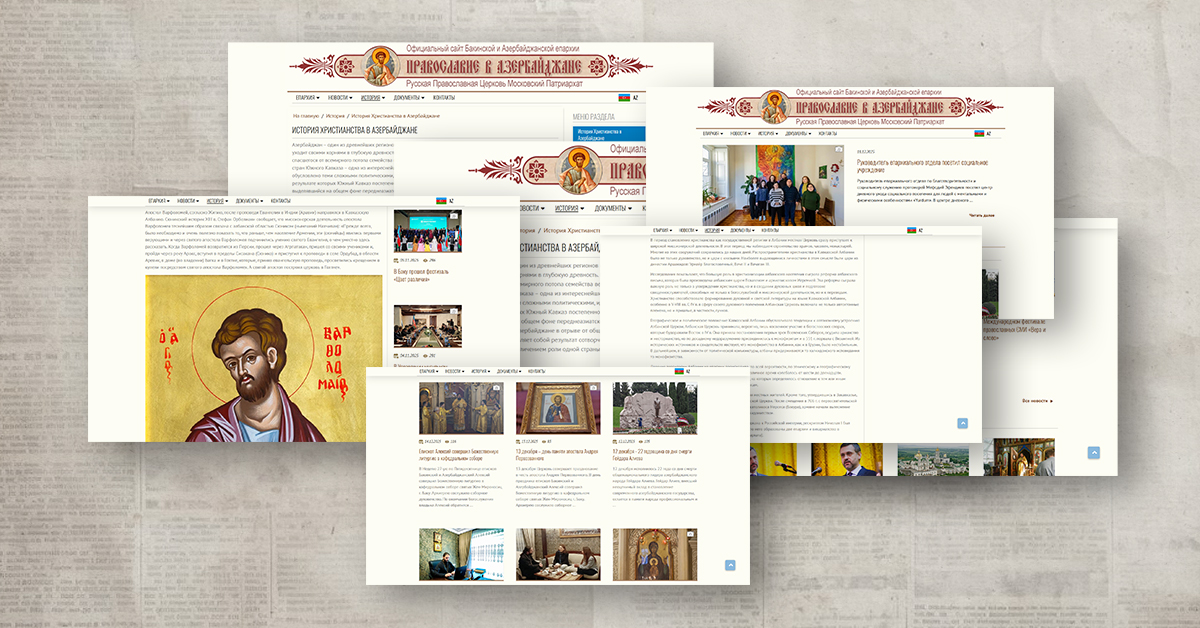
The Armenian Apostolic Church and the Russian Orthodox Church maintain friendly relations based on Christian solidarity and mutual harmony. However, a visit to the “History of Christianity in Azerbaijan” section of the official website of the Baku and Azerbaijani Diocese of the Russian Orthodox Church appears as though the text was authored by the “historians” of the Aliyev regime.
To better illustrate the issue, it is useful to highlight several claims on the website that are both pseudo-scientific and overtly anti-Armenian. For example, the opening lines of the relevant section assert that the members of Noah’s family first settled the territory of present-day Azerbaijan.
First, it should be noted that the text refers to the Armenian tradition regarding Noah (although the website’s authors deliberately avoid mentioning its Armenian origin), according to which the first place where Noah and his family settled later were called Nakhijevan—literally the first, original settlement. Since Nakhijevan is now part of the Republic of Azerbaijan, the authors of that section use this as the sole basis to claim that Noah settled the territory of Azerbaijan. They ignore the fact that all historical sources identify this location as Armenian, and that the Armenian people are traditionally considered descendants of Noah’s son, Japheth. Neither Albania nor Azerbaijani people or the state of Azerbaijan has any connection to this narrative. Moreover, the Armenian origin of the toponym “Nakhijevan” is deliberately omitted.
After a brief historical overview, the section informs that “when Azerbaijan and Dagestan came under the influence of the Russian Empire, Christianity in the region did not disappear solely thanks to the activities of the Russian Orthodox Church.”
The authors of the text, repeatedly echoing narratives crafted by the Azerbaijani propaganda, slightly deviate from the “general line” but fail to present the events of the early 19th century as an occupation or conquest of present-day Azerbaijani territories by the Russian Empire. These are terms commonly used in Azerbaijan to emphasize the supposed damage inflicted on the country because of twice occupation by Russia and the Russian people. It is important to note, however, that in the early 19th century there was neither a state called Azerbaijan nor an Azerbaijani people; the territories annexed to the Russian Empire were the Iranian khanates in the eastern Caucasus. Interestingly, one wonders why the clergy of the “occupying” country and people would go to such lengths to serve a nation and state that are steeped in anti-Russian and anti-Christian sentiment.
The text contains a passage that calls into question the fact that the Armenian Church was the first state church. Moreover, it attempts to “Albanize” the activities of Christ’s apostles, Thaddeus and Bartholomew, portraying them exclusively in connection with the establishment of the Church of Caucasian Albania. Their missionary work, martyrdom, and the founding of the Armenian Church in Armenia are completely omitted. Furthermore, when discussing the activities of Saint Bartholomew, even the Armenian region of Syunik is depicted as part of Albanian territory.
The authors not only attempt to present the people of Syunik as an Albanian population, but also, by citing the 13th-century Armenian historian Stepanos Orbelian’s work (History of the Province of Sisakan), deliberately present him merely as a “Syunikian” — which, in the logic of the authors, implies not Armenian but Albanian origin. They intentionally distort the passage in Orbelian’s work stating that “among the Armenians, the people of Syunik were the first to accept Christianity.” In the website’s text, this reference is reformulated as follows: “Before the population of Armenia, the people of Syunik accepted the doctrine preached by Saint Bartholomew.” This is a clear example of the “Buniatov-style” approach, where sources are manipulated and reinterpreted to suit Azerbaijani propaganda and a fabricated historical narrative.
Echoing Aliyev’s propagandists, the authors of the text also advance the fabricated, pseudo-scientific claim that the settlement of Alban is identical to the city of Baku. It should be recalled that medieval sources mentioning Alban consistently describe it as a locality situated within Greater Armenia—most likely referring to the Aghbak district of Vaspurakan and its center, the settlement of Aghbak. Moreover, Metropolitan Macarius Bulgakov, a prominent historian of the Russian Orthodox Church, also mentioned it.
The authors introduce a fabricated legend in an attempt to locate the martyrdom of Saint Bartholomew in the area of Baku, near the Maiden Tower. Another fabricated story is that Saint Bartholomew is the patron saint of the city of Baku. There is no historical source or reference indicating that Saint Bartholomew ever visited or was martyred in Baku; moreover, no such city existed in the first century. It should be recalled that both Saint Bartholomew and Saint Thaddeus preached and were martyred in the territory of Greater Armenia. Monasteries were later built at their places of martyrdom: the Monastery of Saint Thaddeus in the district of Artaz, in present-day Iran, and the Monastery of Saint Bartholomew in the Aghbak district of Vaspurakan, in present-day Turkey.
When telling about the second phase of the spread of Christianity, the website attributes it to Gregory the Illuminator. However, they deliberately avoid mentioning that he was the spiritual leader of the Armenian people and that, through his efforts, Christianity was proclaimed the state religion of Greater Armenia in 301. Instead, they promote a contrived narrative according to which Caucasian Albania played a more significant and independent role in spreading Christianity in the region than Armenia and Iberia. According to the Armenian historian Agathangelos, in The Life of Gregory, Gregory the Illuminator, after baptizing Tiridates III, king of Armenia, also baptized the king of Albania (most likely Urnayr, who was then in Greater Armenia). Historical accounts further indicate that Gregory the Illuminator sent a man named Thomas to preach Christianity in Albania. Later, the grandson of Gregory the Illuminator, Grigoris preached Christianity there and was martyred; his relics were subsequently buried at the Amaras Monastery in Artsakh.
The text refers to the existence of an Albanian script, yet it makes no mention of the fact that, according to the 5th-century Armenian biographer Koryun, Saint Mesrop Mashtots invented an alphabet for one of the Albanian tribes—an initiative that likewise facilitated the spread of Christianity in Albania.
That text also states that the Church of Aghvank (Caucasian Albania), allegedly from 551 onward, joined the Monophysites and severed its ties with the Byzantine Orthodox Church. This claim is a falsification and a misconception directed against the Armenian Church. The Armenian Apostolic Church and the Church of Aghvank that followed its confession are not Monophysite, but rather: “…Monophysitism is the denial of the Savior’s human nature, which has always been categorically rejected by the Armenian Church. This misunderstanding is based on an incorrect translation of the Armenian term miabanakutyun, which does not mean the uniqueness of Christ’s divine nature, but the unity of His divine and human nature. Therefore, it should be translated as miaphysitism, not Monophysitism.”
It should be emphasized that originally the Church Albania accepted the primacy of the Armenian Apostolic Church and was subordinate to it. Under the direct influence of the Armenian Church, the Church of Albania adopted the same position as the Armenian Church at several ecclesiastical councils that discussed the most important doctrinal and political issues (the Councils of Dvin in 506 and 554), and severed its relations with the Byzantine Church.
Let us recall that in the 6th century the center of the Church of Albania was moved to the city of Partav, in the Armenian province of Utik. Later, by the end of the 14th century, it was established in Artsakh, at Gandzasar. Thereafter, it also functioned under the name of the Catholicosate of Gandzasar, as an institution operating within the Armenian Apostolic Church.
The authors of the material also repeat the thesis of the Azerbaijani propaganda, according to which in 1836 the Russian Emperor Nicholas I abolished the Church of Albania and merged it with the Armenian Church of Etchmiadzin. It should be recalled that at that time the Catholicosate of Gandzasar, or of Albania, was already part of the ecclesiastical structure of the Armenian Church. The imperial statute of 1836 (the Polozhenie) merely established direct state control over the Armenian Church that had come under imperial rule. In fact, regarding the Catholicosate of Gandzasar as a spiritual institution within the system of the Armenian Church, the tsarist authorities simply stripped it of its catholicosal status and allowed only the Catholicos of All Armenians in Etchmiadzin to bear the title of Catholicos within the territories under their control.
Shortly thereafter, two archiepiscopal dioceses of the Armenian Apostolic Church were also established in the region of Eastern Transcaucasia: the Karabakh (Artsakh) Diocese on the right bank of the Kura River, and the Shamakhi Diocese on the left bank of the Kura. In their centuries-old homeland on the left bank of the Kura River (historical Albania), the community of several thousand Udis remained part of the Armenian Diocese of Shamakhi until the beginning of the 20th century.
As we can see, the “History of Christianity in Azerbaijan” section on the website of the Baku and Azerbaijani Diocese of the Russian Orthodox Church operating in the territory of the Republic of Azerbaijan fully reproduces the views of the notorious propagandist of Aliyev’s regime, “archpriest” and “knight” Alexei Nikonorov. These, in turn, stem from the false and fabricated narratives put forward by Azerbaijani historians.
The aim of this is:
The authors of the official website of the Baku and Azerbaijani Diocese of the Russian Orthodox Church should be reminded that the duty of Christian clergy is to speak in the name of truth and justice, not to accommodate the falsifications promoted by the Aliyev regime. In pursuing its policy of destroying and appropriating Armenian Christian heritage, Azerbaijan also exploits the Christian Udi community, which, in effect, are political hostages within the state.
We hope that the content published on that website and discussed above does not reflect the official position of the Russian Orthodox Church. Rather, it represents the actions of a group of “errant” historians seeking to demonstrate their loyalty to the Azerbaijani authorities.
Bibliography
Kharatyan, Hr., The New “Missions” of the Ancient Apostles: The Russian Orthodox Church and the “Albano-Azerbaijani” Expectations from the Apostle Bartholomew, Handes Amsorya, 2025, no. 1, pp. 238–322.
Macarius Bulgakov, History of the Russian Church (https://predanie.ru/book/73592-istoriya-russkoy-cerkvi/; https://azbyka.ru/otechnik/Makarij_Bulgakov/istorija-russkoj-tserkvi/1_6).
Saint Grigor Tatevatsi, Zlaotochrev, trans. from Classical Armenian, introduction and notes by A. K. Matevosyan, Yerevan, 2022.
Hakobyan, A., Albania–Aluank in Greek-Latin and Classical Armenian Sources. Second, revised edition, Yerevan, 2022.