
“GEGHARD”
SCIENTIFIC ANALYTICAL
FOUNDATION


2026
2026
2026-10-26
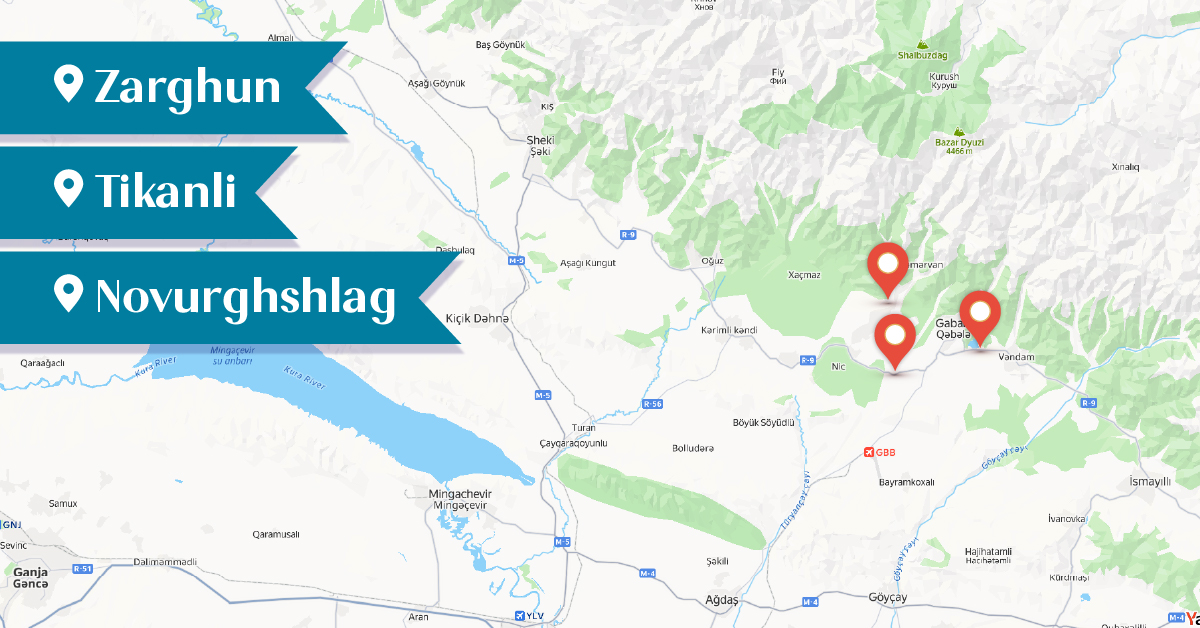
Zarghun
The village of Zarghun is located approximately 6 km from the district center of Kutkashen (present-day Gabala). The settlement has also been mentioned under the names Zaraghan and Zergun. Near the village lies the Zarghun Plain, which is considered the site of the martyrdom of the Apostle Yeghishe. Zarghun is one of the settlements in eastern Transcaucasia whose Armenian inhabitants converted to Islam in the 1720s and lost their national identity. According to 19th-century Russian statistical records, the Muslim Armenians of Zarghun were recorded as Tatars. Today, the village’s population identifies as Azerbaijani.
Tikanli
The village of Tikanli is located approximately 9 km northwest of the district center of Kutkashen (present-day Gabala), near the villages of Bum and Mekhlughavakh. The settlement is also known by the variants Tikanlu, Tikyanlu, and Tkyanlu.
In the 1720s, the Armenian inhabitants of the village were also forcibly converted to Islam. Interestingly, even in 1889, the residents of Tikanli were recorded as Muslim Armenians. At that time, traces of an Armenian cemetery and church were still visible in the village. However, in Russian statistical sources from 1908 and 1914, the local inhabitants were recorded as Tatars. In the 20th century, following the emergence of the state of Azerbaijan, the residents of Tikanli were also mentioned as Azerbaijanis.
Novurghshlag
The former Armenian village of Novurghshlag in eastern Transcaucasia is located approximately 5 km southeast of Kutkashen, near Lake Novur (Nohur). In the 1720s, the village’s population was forcibly converted to Islam and gradually became detached from the Armenian community.
A record has been preserved stating that in 1887, two books were discovered embedded in the wall of one of the village’s houses. One was a printed Jashots (Lectionary), dating to the 17th century. The other was a handwritten Armenian manuscript. The manuscript was dated to the year 1033 (probably according to the Armenian calendar, corresponding to 1584 CE) and contained approximately 600 pages. This suggests that many Armenians hid their sacred books during the period of religious conversion.
Today, the inhabitants of Novurghshlag identify as Azerbaijanis.
Bibliography
A. A., “A Letter from Nukhi,” Mshak, 1887, No. 38, April 11, p. 2.
Barkhutareants, M., The Land of the Aghvank and Its Neighbors. Artsakh, Yerevan, 1999, pp. 39, 61, 125, 147, 148.
Yeghiazareants, V., “Some Information about the Udis,” Ardzagank, 1887, No. 12, April 5, p. 181.
Khoi-Zade, Nor-Dar, 1895, No. 223, December 19, p. 2.
Karapetyan, S., Aghvank Proper. Research on Armenian Architecture Foundation, 2024, Book XXII, Part 1, pp. 256–257, 310–311.
Mazhak, “Materials Concerning the Udis,” Meghu Hayastani, 1881, No. 123, July 1, p. 1.
Mazhak, “Vardashen and Nij in the Nukhi District,” Meghu Hayastani, 1879, No. 81, October 20, p. 1.
Movses Kaghankatvatsi, History of the Land of the Aghvank. Yerevan, 1969, p. 11.
Caucasian Calendar for 1910. Tiflis, 1909, pp. 255, 379.
Caucasian Calendar for 1915. Tiflis, 1914, pp. 125, 188.