
“GEGHARD”
SCIENTIFIC ANALYTICAL
FOUNDATION


2026
2026
2026-08-24
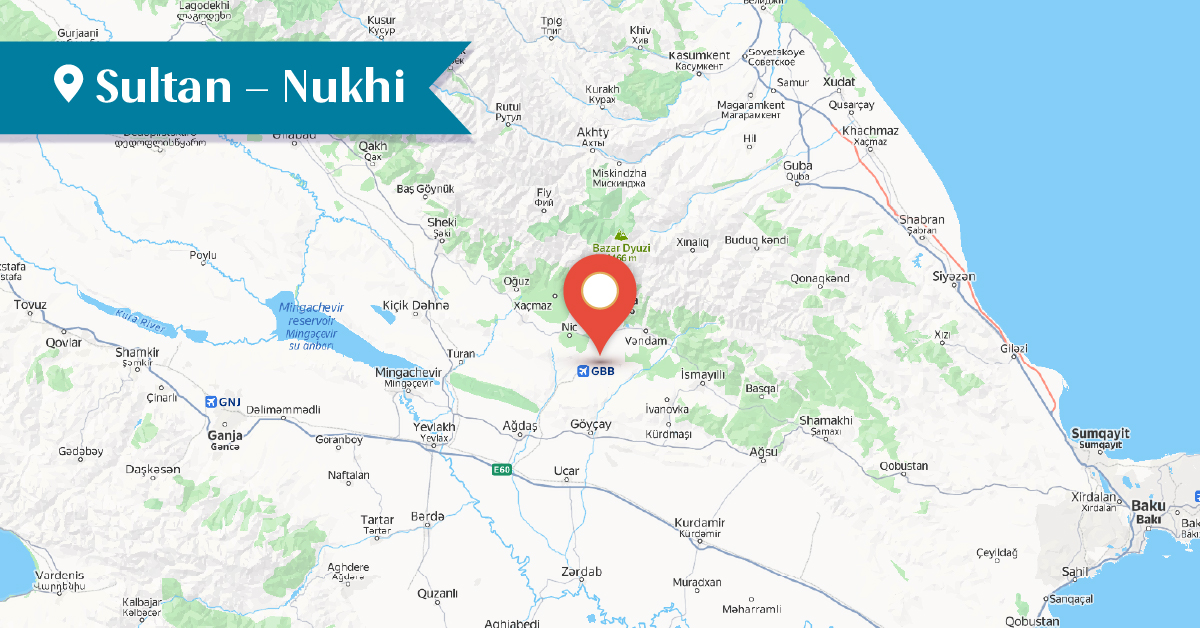
Sultan-Nukhi village is located approximately 11 km southwest of the eponymous district center of the Kutkashen district (present-day Gabala). The village is also known as Gabala-Nukhi.
Sultan-Nukhi was founded in the 18th century. In addition to Christian Armenians, Muslim Armenians also lived in the village, mainly in the Tapa-Mahla neighborhood.
In 1841, the village had a population of 338, while ten years later, the Armenian population had reached 668. In 1874, Sultan-Nukhi had 1,027 inhabitants, and in 1886, 868. In 1890, the Armenian population of the village numbered 1,019; in 1901, 983; and in 1908, 952. In 1912, 1,061 Armenians lived in Sultan-Nukhi, while in 1914 their number had reached 1,110. In 1917 the village had only 160 Armenian households; the remainder of the population consisted of Armenians who had been Turkicized.
In 1886, an Armenian school was opened in the village, with 30 students enrolled. In 1889, it is recorded that the school, known as Surb Sahakyan, had 33 students and one teacher. The school was closed in 1894 and reopened in 1914, when it had 43 students.
There were two Armenian churches in Sultan-Nukhi. The Church of Surb Astvatsatsin (Holy Mother of God) was located in the western quarter of the village. Restoration work on the church began in 1872–1873. This is attested by an inscription above the church’s southern entrance:
This stone was brought by Khachatur Atabekyants.
On September 10, 1873, this Church of the Holy Mother of God
was built at the expense of the community,
during the priesthood of Father Avetis Ter-Israyelyants of Sultan-Nukhi.
On the northern side of the church, near the baptismal font, there was another inscription:
This holy font is a memorial
to the priest Galust and his wife Sandukht,
and their sons Ghara zin, Ohan, and Abraham.
These inscriptions were still preserved in 1986, when monument researcher Samvel Karapetyan visited Sultan-Nukhi.
Both churches in the village had priests. Among those mentioned are: Ter Daniel (18th century); Ter Israel (early 19th century, died in 1807), Karapet Ter-Israyelyants (served from 1812 to 1845), Zakaria Mikayelyan (served from 1817 to 1849), the priests Khachatur, Avetik, and Arakel (mentioned in 1843); Petros Ter-Karapetyan-Ter-Israyelyants (served from 1850 to 1877), Hovhannes Ter-Zakaryan (mentioned in the second half of the 19th century), Avetik Ter-Israyelyants (served from 1870 to 1908 and was a native of Sultan-Nukhi), Harutyun Atakishiyan (Harutyunyan)-Ter-Zakaryants (served from 1879 to 1910), and Suren Ter-Zakaryants (served from 1910 to 1914).
Two mosques existed in the quarter inhabited by the Muslim Armenians of the village. There were Armenian cemeteries in Sultan-Nukhi, one of which was located near the Church of Surb Astvatsatsin (Holy Mother of God). The tombstones preserved there bore inscriptions. Below, we present several of them:
This is the tomb of Anna, the wife of Ter Israel, 1795.
This is the tomb of Minas, son of Akar, a native of Gabala-Nukhi, May 10, 1815.
This is the tomb of Hovsep, son of Sargis, a native of Gabala-Nukhi. Whoever encounters this [tomb], say with a sincere heart, ‘May God have mercy [on him],’ and may God have mercy on you. 1819.
This is the tomb of Mariam, daughter of Ter Zakaria, wife of Hovhannes, and mother of Karapet, the priest. She passed away on April 8, 1844.
This is the tomb of Ter Karapet, son of Ter Israel, whose grandfather was the priest, the venerable Ter Daniel. They are a priestly family, native to Sultan-Nukhi. In the 30th year of his life he was ordained; after serving the village as its priest for sixty years, he passed away. Whoever encounters this tomb, let him not pass by without saying: ‘Lord, have mercy.’ In the year 1846, on the 4th day of May, he passed away. I beseech you, passers-by, and ask you to say: ‘Lord, have mercy’; and those standing nearby, with attentive minds, let them show mercy.
Another tombstone was found in the eastern quarter of the village, bearing the inscription: “Christ God, have mercy on Irstam, in the year ME.”
Near the village lies Vankasar, where the ruins of a once-existing monastery that served as the episcopal seat of Kapaghak in the 5th–7th centuries have been found.
Like the Armenians of other surrounding Armenian villages, the Armenian population of Sultan-Nukhi also suffered during the events of 1918, when Ottoman forces that invaded the region, together with local Caucasian Tatars, destroyed Armenian settlements throughout Eastern Transcaucasia. Nevertheless, following these events, Armenians continued to live in the village, remaining there until their forced displacement in 1988.
Literature
“Ararat,” 1886, No. XI, p. 503.
“Ararat,” 1913, Nos. VIII–IX, p. 687.
“Ararat,” 1914, No. III, p. 201.
“Ararat,” 1915, Nos. XI–XII, p. 824.
“Ardzagank,” 1884, No. 32, August 19, p. 478.
“Ardzagank,” 1887, No. 4, February 8, p. 56.
Barkhudaryants, M., The Land of Aghuank and Its Neighbors: Artsakh. Yerevan, 1999, pp. 125–126.
T. P., correspondence, “Nor-Dar,” 1889, No. 65, April 29, p. 3.
Karapetyan, S., “The Turkophone Armenian Villages of the Historical Armenian Province of Kapaghak,” Herald of Social Sciences, 1988, No. 1, pp. 40–46.
Karapetyan, S., Armenian Inscriptions of Aghvank Proper, Book I. Yerevan, 1997, pp. 44–46.
Karapetyan, S., Aghvank Proper. Foundation for the Study of Armenian Architecture, 2024, Book XXII, Part 1, pp. 315–324.
“Horizon,” 1917, No. 44, March 1, p. 3.
Mazhak, “Vardashen and Nij in the Nukh district,” Meghu Hayastani, 1879, No. 81, October 20, p. 1.
“Mshak,” 1914, No. 81, April 18, p. 2.
“Nor-Dar,” 1887, No. 210, December 4, p. 2.
“Nor-Dar,” 1889, No. 186, November 8, p. 2.
“Nor-Dar,” 1892, No. 140, September 8, p. 1.
“Nor-Dar,” 1893, No. 192, November 2, p. 2.
Prom-zu, correspondence, “Nor-Dar,” 1890, No. 68, May 29, p. 3.
Sevordi, correspondence, “Nor-Dar,” 1894, No. 97, June 10, p. 3.
Ter-Grigoryants, H., “Letter to the Editor,” Mshak, 1882, No. 182, October 2, p. 2.
Ter-Zakaryan, S., “On the School Question,” Mshak, 1914, No. 81, April 18, p. 2.
Tonyan, A., “Sultan-Nukhi,” Horizon, 1917, No. 8, January 13, p. 3.
Alphabetical Lists of Armenian Gregorian Churches and Mohammedan Mosques in the Empire. Department of Religious Affairs of Foreign Confessions, 1886, pp. 58–59.
Caucasian Calendar for the Year 1910. Tiflis, 1909, p. 367.
Caucasian Calendar for the Year 1915. Tiflis, 1914, p. 183.