
“GEGHARD”
SCIENTIFIC ANALYTICAL
FOUNDATION


2026
2026
2026-07-27
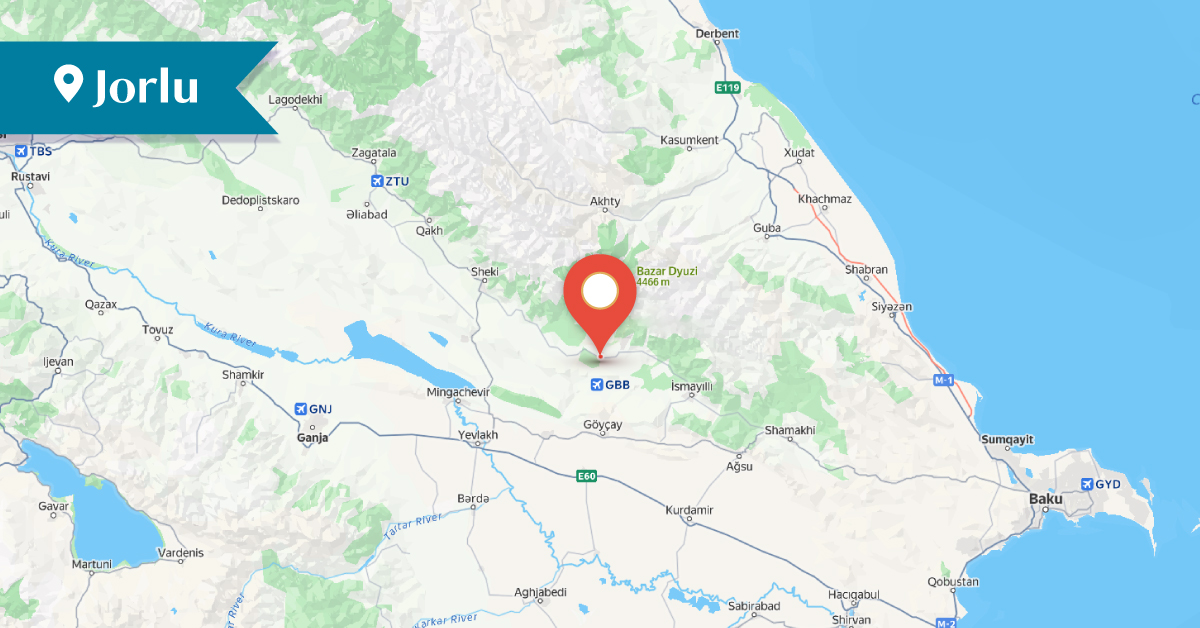
Jorlu village of Kutkashen district was located approximately 12 km southwest of the district center of Kutkashen (present-day Gabala). It was also known by the alternative names Hay Jorlu ("Armenian Jorlu") and Chorlu.
This Armenian settlement was first mentioned in written sources in 1725, when "Allahverdi of Churlu", presumably the village ruler, signed a petition addressed to Emperor Peter I of Russia by representatives of Armenian-populated villages of the Kapaghak district, requesting Russian assistance.
According to one account, Armenian families who had left Artsakh also settled in the village toward the end of the eighteenth century. There is another reference to Jorlu: on 4 August 1896, the village was struck by a flood that caused considerable damage.
According to 1841 records, Jorlu had 259 Armenian inhabitants. By 1879, the Armenian population had increased to 301. In 1886, the village had 291 Armenian residents, rising to 345 in 1889. According to 1901 data, the population stood at 310, increasing to 370 in 1908 and reaching 397 by 1914.
Although the Armenians of Jorlu were predominantly Turkic-speaking, the written language used in the village was Armenian. An Armenian school was operating in the village by 1914, with 41 pupils enrolled. The school was listed among the educational institutions of the Diocese of Artsakh (Karabakh) that were in severe financial difficulty. Armenian inscriptions were also found on the gravestones in the village cemetery.
The village was home to the Holy Mother of God (Surb Astvatsatsin) Church, the earliest known reference to which dates to 1839. The church, however, soon fell into disrepair, forcing the Armenians of Jorlu to attend services at the church in the neighboring village of Mirzabeklu. Among the clergymen who served the village were Fr. Abraham, Fr. Poghos Ter-Abrahamyan, Fr. Sahak Ter-Stepanosyants, Fr. Martiros Hakhverdyan, Fr. Meliksedek Hovsepyan-Khachatryants, Fr. Avetik Ter-Mikayelyan, Fr. Mkrtich Ter-Astvatsatryants, and Fr. Daniel Davtyan-Ter-Avagyants.
Nevertheless, a new church was eventually built in the village. When the folklorist and historian Samvel Karapetyan visited Jorlu in 1986, the church was still standing. During the Soviet period, the building used as a community club, a school, and later as a warehouse. Karapetyan also documented dozens of gravestones in the Armenian cemetery, although inscriptions had survived on only four of them.
This is the tomb of Ter Abraham of Jorlu, Ghabalu. 1815.
This is the tomb of Surma, the wife of Martiros. 1817.
This is the tomb of Melkum, son of Shahsuvar. Whoever reads this, say, ‘May God have mercy.’ 1857.
This is the tomb of Allahveran, son of Hambardzum Osmaneants. His mother was Nubar, his wife was Zarn/shan, and his sons were Grigor and … Gyulkeazar.
Like the other surrounding Armenian villages, Jorlu was devastated during the events of 1918, when Ottoman forces, together with local Caucasian Tatar armed groups, massacred a large part of the Armenian population of the eastern South Caucasus. In the aftermath of these events, the village was resettled by Turkic-speaking inhabitants. Today, Jorlu is populated by Azerbaijanis.
References
Barkhutareants, M. The Land of Aghvank and Its Neighbors. Artsakh, Yerevan, 1999, p. 126.
Karapetyan, S. Armenian Inscriptions of Historical Aghvank, Book I. Yerevan, 1997, p. 43.
Karapetyan, S. Historical Aghvank. The Research on Armenian Architecture (RAA) Foundation, 2024, Vol. XXII, Part 1, pp. 312–315.
Hovsepyants, Lazaros, Rev. Letter to the Editorial Board. Nor Dar, 1890, No. 70, June 1, p. 2.
Nor-Dar, 1896, No. 185, October 19, p. 3.
Alphabetical Lists of Armenian Gregorian Churches and Muslim Mosques in the Empire. Department of Spiritual Affairs of Foreign Confessions, 1886, pp. 26–27.
The Caucasian Calendar for 1910. Tiflis, 1909, p. 244.
Ezov, G. A. Relations of Peter the Great with the Armenian People. Documents. St. Petersburg, 1898, pp. 427–428.