
“GEGHARD”
SCIENTIFIC ANALYTICAL
FOUNDATION


2026
2026
2026-06-06
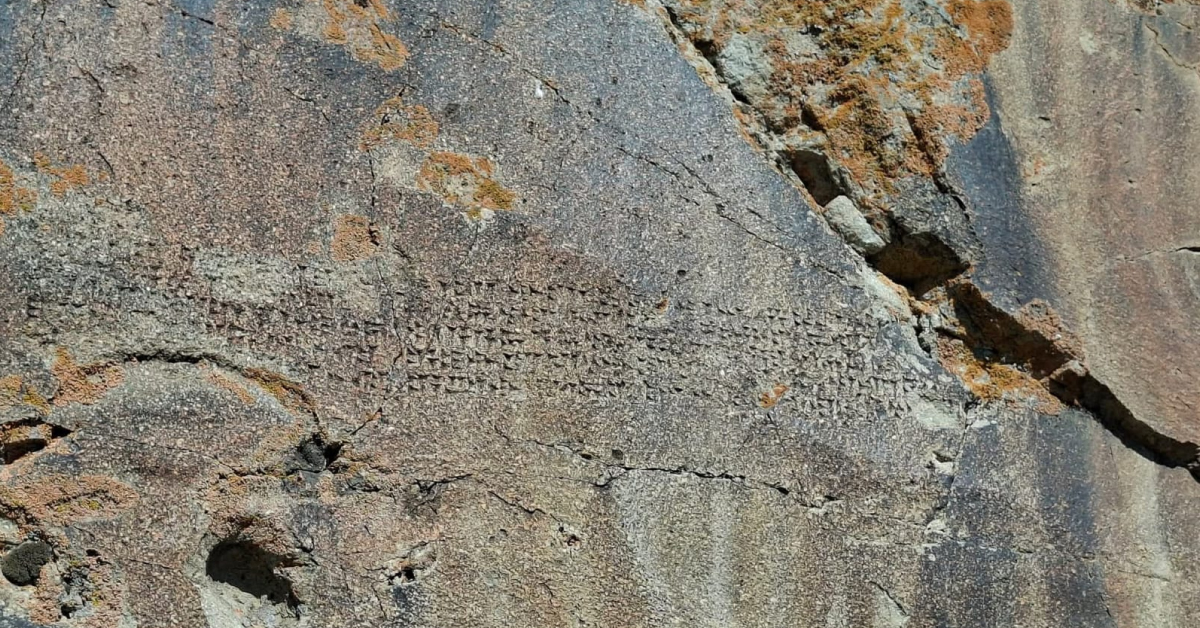
Recently, Azerbaijani archaeologists announced their “exceptional discovery.” According to them, a 2,800-year-old Urartian inscription was found on the rock known as Odzasar (Ilandagh) in the territory of the Nakhichevan Autonomous Republic, which had remained unknown for more than four decades due to the absence of precise location data.
Let us refresh the memory of Azerbaijani archaeologists.
The Urartian cuneiform inscription was discovered as early as 1988 by geologist-archaeologist Valery Igumnov.
In the article titled “The Cuneiform Inscription of Odzasar,” published in the first issue of Patma-Banasirakan Handes (Historical-Philological Journal) in 1997 (authored by V. A. Igumnov, H. H. Karagyozyan, and S. G. Hmayakyan), the inscription is described in detail, including its location, translation, content, and scholarly interpretations. The inscription was carved in the last quarter of the 9th century BCE, in the 820s BCE. It was composed in the name of Ishpuini but was ordered to be carved by Menua.
This inscription, discovered in 1988, was photographed, documented, and measured again in 1989 by V. A. Igumnov.
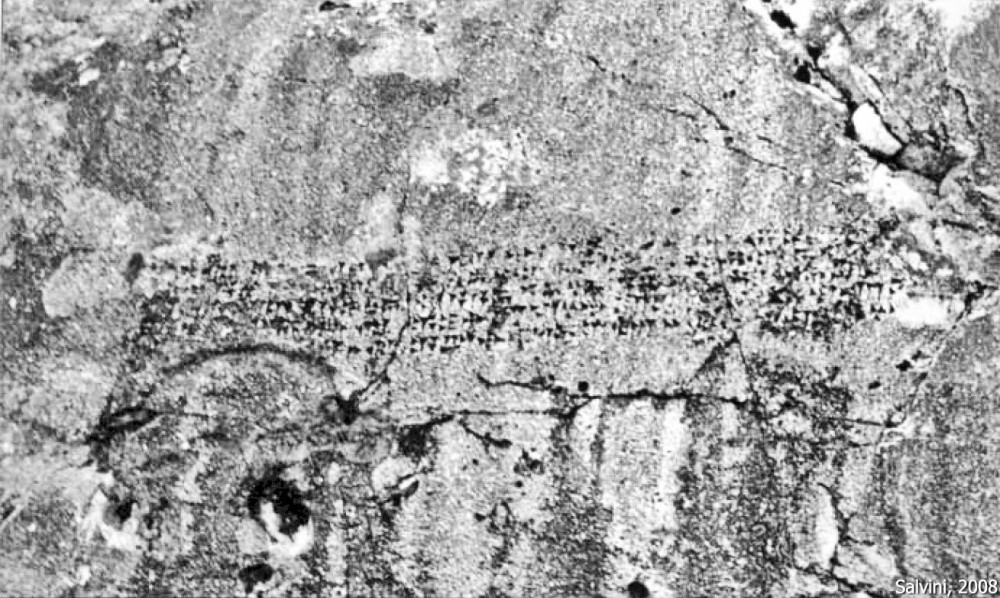
Photo by V. A. Igumnov, 1989
The Institute of Archaeology and Anthropology of the National Academy of Sciences of Azerbaijan states that the inscription is an important source for studying the ancient history of the region, presenting it as part of Azerbaijan’s historical heritage.
The interpretations surrounding the inscription reflect the official Azerbaijani narrative, in which many Armenian monuments in the region are presented as “Azerbaijani” heritage.
By the protection of the god Khaldi, Ishpuini, son of Sarduri, and Menua, son of Ishpuini, conquered the city of Arsini. They (literally: he) defeated the land of the city of Arshini, conquered the land of the city of Aniani, and destroyed it. That (?) […] was. He erected a stele for the god Khaldi. In the land of Puluadi, he established a ritual. The (ritual performer) was allowed to sacrifice an ox to the god Khaldi and a cow to Puluadi, the wife of the god Khaldi.
This inscription relates to the military and religious policies of the Urartian period. The text mentions the kings Ishpuini and Menua (9th–8th centuries BCE). These rulers are known for strengthening Urartu through the construction of fortresses, the conquest of territories, and the establishment of the cult of the god Khaldi as the official religion.

Photo by V. A. Igumnov, 1989
The conquest of the cities of Arsini and Aniani demonstrates Urartu’s policy of territorial expansion. The words “conquered” and “destroyed” emphasize the Urartians’ military victory as a display of power. The erection of a stele for the god Khaldi after the victory was characteristic of the Urartian tradition of linking military successes to divine patronage. Khaldi was the supreme deity and god of war in Urartu, and his cult reinforced the king’s legitimacy. Moreover, the performance of a special ritual in the conquered territories—offering sacrifices to Khaldi and his “wife”—immediately established the Urartian religious system as an instrument of political control.
Located on the western slope of Mount Odzasar in the Julfa (Jugha) district of Nakhijevan, near the Armenian settlement of Khoshakunik, the 100 cm-long inscription consisting of five lines and weathered over time has recently become a tool of Azerbaijani political propaganda. Artificially linking it to modern national identities obscures the inscription’s true historiographical value and significance.