
“GEGHARD”
SCIENTIFIC ANALYTICAL
FOUNDATION


2026
2026
2026-03-09
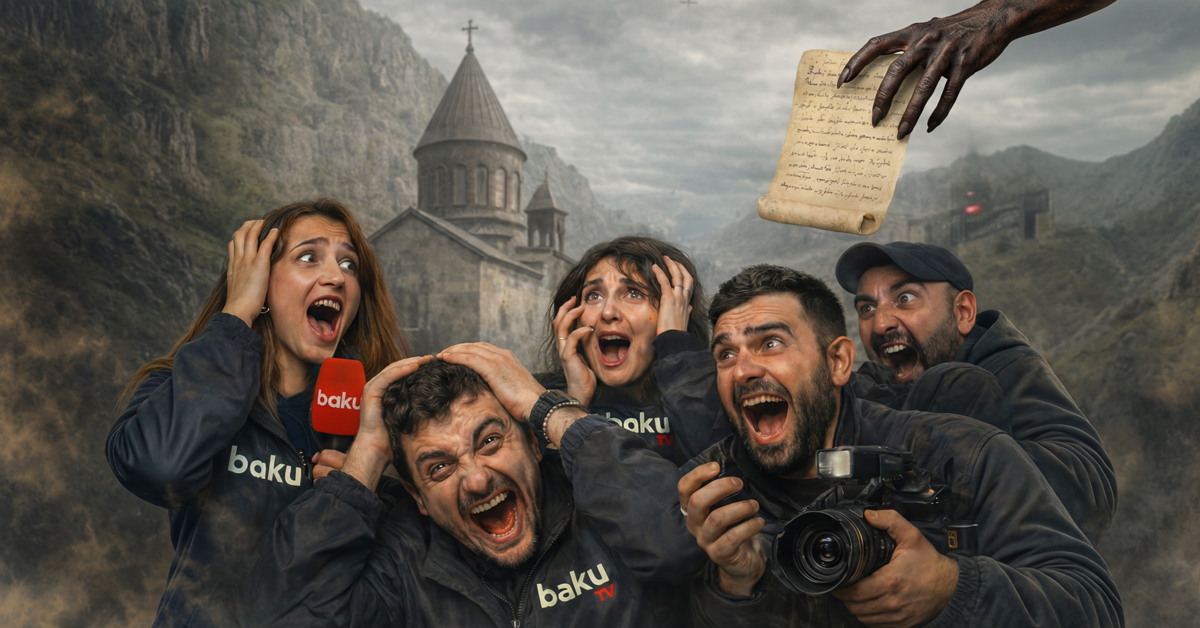
Recently, Baku TV aired a report about the “scientific-analytical center” Geghard Foundation. The pretext was the publications of Geghard that expose Azerbaijani claims over Armenian historical and cultural heritage and the promotion of the fabricated thesis of “Western Azerbaijan.” According to this concept, the implementation of the “appropriation” of other’s heritage is entrusted to the Azerbaijan National Academy of Sciences and other state institutions. Particular attention should be paid to the Academy itself, the institution where the last three presidents have been convicted of corruption, and where recently sleeping academicians became notorious during the Academy’s annual meeting session for their epic postures.
The selection of the Academy for the mission of “appropriation” is logical due to its experience. In the Azerbaijani academia, the skill of appropriation has been perfected— and not only when it comes to Armenian heritage. An example? The previous president of the Azerbaijan National Academy of Sciences, Isa Habibbeyli, “appropriated” so successfully that his daughter managed to buy villas in Berlin, open bank accounts worth millions of dollars, and eventually disgrace herself, her father and the Academy. Simply put: at the expense of ordinary Azerbaijanis and state budget funds, “centers for the study of the art and history of ‘Western Azerbaijan’” are being established—centers that, in essence, study of fabrication. Money is spent on myths, while poverty and corruption flourish in the country. The experience of appropriation is well established; therefore the appointment is logical.
The producers of Baku TV are particularly comical when they try to explain the origin of the name of the Geghard Foundation. First, they triumphantly declare that it is a “falsification” of the name of the monastery “Eyrivank.” In reality, “Eyrivank” is simply a distorted Turkic pronunciation of the Armenian monastery name “Ayrivank,” which is also known as Surb (Holy) Geghard. The channel then descends into a complete absurd, declaring Geghard to be an ‘Albanian-Kipchak Christian monastery’.
For the information of Baku TV and the so-called “scientific” centers, it should be recalled that already in the mid-19th century—when neither the ethnonym “Azerbaijani” nor a state called Azerbaijan existed—well-known researchers and Orientalists studying the region wrote about Geghard Monastery, testifying to its Armenian origin.
For example, a member of the Russian Imperial Academy, Marie-Félicité Brosset, wrote in one of his studies in 1849:
"Si l'hiver eût été moins rigoureux, je désirais ardemment visiter du moins les couvents de Géghard; et de Khorvirap, et les ruines d'Ani." ("Had the winter been less severe, I would have most ardently wished to visit at least the monasteries of Geghard and Khorviraṗ, and the ruins of Ani.")
Or
"Au couvent de Géghard; ou Aïrivank, sur le mur d'une des églises souterraines, on lit…" ("At the monastery of Geghard, or Ayrivank, on the wall of one of the underground churches, one reads…")[1]
The distinguished Irish geographer and Armenologist Henry Lynch, writing in 1901 — seventeen years before the establishment of the Azerbaijani state — recorded:
"Above the river are found the relics of the city of Garni; and, near the sources of the stream, at a distance of some five miles from Garni, the caves and monastery of Surb Geghard; reputed to have been founded by St. Gregory." [2]
Based on indisputable historical evidence, we would advise Baku TV to be more restrained and competent, and to take into account the testimonies and historical facts recorded by researchers such as Brosset and Lynch—written long before the emergence of the so-called “Albanian-Kipchak” Azerbaijani experts. Dear Baku TV, M. Brosset could not have imagined in 1847–1848 that, two centuries later, someone would declare Geghard to be “Albanian-Kipchak.” We kindly ask you to approach the existence of historical facts with understanding—they are not obliged to reflect the Azerbaijani propaganda.
With this kind of fraudulent logic, Baku TV could next declare that Geghard is an “Albanian-Kipchak-Ugro-Finnish-German-Gagauz” monastery. Such ungrounded things are to be expected from the Azerbaijani propaganda.
Before delving into such etymological fantasies, we suggest that Baku TV first try to explain the etymology of the name of Baku, the capital of Azerbaijan, and why it has no connection with Azerbaijanis. For example, according to Soviet Oriental studies, the name of the city of Baku derives from the Persian expression “Bad-Kube”, meaning “wind-beaten” or “struck by winds” (Great Soviet Encyclopedia, 3rd ed., 1970, vol. 2, pp. 550–552). After familiarizing themselves with this view, we would urge the TV channel in its next video to avoid interpreting Baku as a city “beaten by winds of Azerbaijani origin.”
Finding an “Azerbaijani trace” in the toponyms of Baku or other contemporary cities of Azerbaijan is rather difficult. However, we encourage you not to be discouraged and to continue imaginatively appropriating and declaring any place name or settlement as Azerbaijani. For example, you could interpret Baghdad as “bagh-dede” (“my grandfather’s garden”), the island of Bali as “Azerbaijani Honey Island” (bal means “honey” in Azerbaijani), Warsaw as “var su” (“there is water”), and so on.
In the program, Armenians are portrayed as liars, the history of Armenia is presented as a grand falsehood, and Armenians are labeled a “people with a genocidal past.” In other words, according to the marasmatic logic of Baku TV journalists, the victims of the 1915–1923 genocide are accused of “genocidal actions” against Azerbaijanis. Particular attention should also be paid to the language and tone used in the report about the Geghard Foundation. Insults, rudeness, and the demonization of Geghard are characteristic features of Baku TV’s so-called “ethics.”
The peak of Baku TV’s “ethics” is the segment in which the Geghard Foundation is labeled a “den of demons.” It is hard to say what exactly is at play here—childhood psychological trauma, or a deliberate demonization of Geghard. Science explains. In the first case, the authors can be comforted: demons and devils do not exist. To be sure, we recommend consulting psychologists.
In the second case, if the Geghard Foundation is being deliberately demonized, this only exposes the fears of the Azerbaijani propaganda machine—fears that have arisen as a result of the Foundation’s successful activities in exposing falsifications. They are ordinary researchers and specialists engaged in rigorous, objective scholarship: Armenian studies, Oriental studies, and cognate historical disciplines, who expose falsifications pertaining to the history and culture of Armenia and of neighbouring countries and peoples.
[1] Brosset, M. Rapports sur un voyage archéologique dans la Géorgie et dans l'Arménie: exécuté en 1847-1848 sous les auspices du prince Vorontzof, leutenant du Caucase. St.-Pétersbourg: Imprimerie de l'Académie Impériale des Sciences. 1849-1851, p. 84, 91.
[2] Lynch, H. F. B. 1862-1913. (1901). Armenia, travels and studies. London: Longmans, Green, and co., p. 201, 382.