
“GEGHARD”
SCIENTIFIC ANALYTICAL
FOUNDATION


2026
2026
2026-03-02
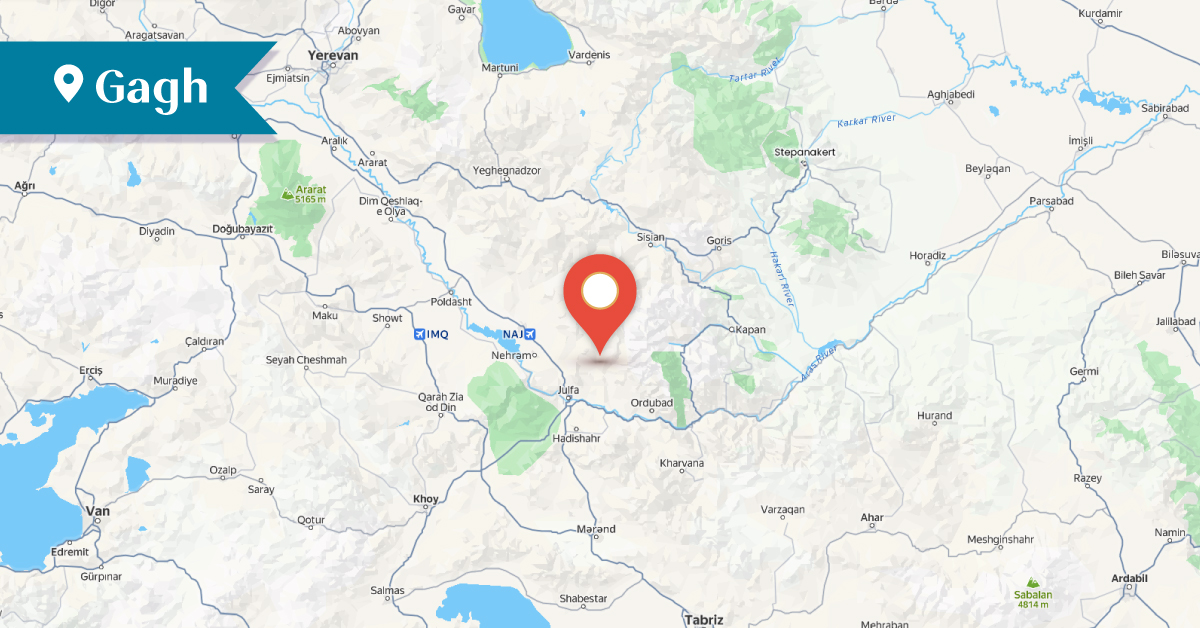
Gagh was one of the Armenian villages of the Yernjak district of the Syunik province of Greater Armenia. It was located on the high mountainous terrain of the Yernjak district, on the eastern slopes of Mount Odzasar. It was an ancient settlement where the life of the Armenian population developed from the early Middle Ages through the late Middle Ages. The village had around 700 Armenian households.[1]
The village was first mentioned in the 13th century by the prominent Armenian historian Stepanos Orbelyan. He noted that the village paid an annual tax of 12 dahekans to the Tatev Monastery.[2]
The Armenian population of Gagh suffered great losses in the early 17th century as a result of the Turco-Iranian wars, especially due to the campaigns of Shah Abbas I and later Nader Shah. The Armenian inhabitants of Gagh were forced to migrate mainly to Izmir, Constantinople, and other places. The last Armenian families of the village moved to Soviet Armenia between 1960 and 1964, settling mainly in Yerevan and its surrounding areas.[3]
Merchants from Gagh were engaged in commercial activities, reaching as far as Europe. Manuscripts copied on the orders of these merchants have been preserved.[4]
Mentions of Gaghi merchants are found in Venice. Between 1698 and 1725, the name of Hakob form Gagh is recorded on one of the columns of St. Mark’s Cathedral. The cleric Astvatsatur, as well as Hovhannes and Baghin (Baghdasar), are also mentioned.[5] In 1571, in Florence, a Latin-Armenian Jashots (Lectionary) was written by Father Abel from Gagh.[6]
As late as the early 19th century, numerous traces of buildings and monuments were still visible in the ruins of historical Gaghi. In the village cemetery, more than 1,000 tombstones with inscriptions dating from the 14th to the 18th centuries have been preserved.
As early as the beginning of the 19th century, numerous traces of buildings and monuments were still visible in the ruins of historical Gagh. In the village cemetery, more than 1,000 tombstones with inscriptions dating from the 14th to the 18th centuries have been preserved.
Some of Gagh’s monuments are located to the northwest of the village, in the area known as the “Valley of the Stonecutters.” Here lie the ruins of the Chapel of St. Gayane, the churches of St. Hripsime and St. Nahatak (Holy Martyr), as well as the Monastery of St. Anapat. In the surroundings of the village, the ruins of the chapels of St. Eghia, St. Sargis, and the fortress are also known.[7]
The spring associated with the Church of St. Hripsime was renowned for its healing qualities. It was known by the name “Gyal-Jarajur.” According to a story, the holy virgin Hripsime hid the relics she had brought with her in a place called Gyagh. “When the infidels found and killed Hripsime, at that very spot a spring emerged through the miraculous power of the relics, meant to wash away the blood of the innocent victims.” [8] According to legend, the name Gagh derives from the act of keeping—hiding (gaghel)—the relics of the virgin Hripsime in that place.[9]
Among the architectural monuments of Gagh, the Monastery of St. Gregory the Illuminator is particularly noteworthy; it was still standing in the early 1990s. The monastery was founded in the 12th–13th centuries. It is known that, along with a number of monasteries and churches in Goghtn and Yernjak, this monastery was renovated in 1658–1659 by Catholicoi Movses and Pilipos.[10] The entrance of the church was on the western facade. The church had storerooms and secret hiding places where the monastery’s relics and manuscripts were kept. The wall paintings of this church were made by painters of the Hovnatanian family from the neighboring town of Shorot.[11]
The church was also a well-known scriptorium. Manuscripts copied here and dated to 1657 and 1666 have survived to our days.[12]
Several rock-carved khachkars are installed on the western facade of the church, relating to the monastery’s renovations in the 16th–17th centuries. During the Soviet period, the church was used as a warehouse.
Today, Gagh[13] is located in the Nakhijevan Autonomous Republic and is inhabited by Azerbaijanis, whose first arrival in the village took place in 1965–1966.
Bibliography
Ghevond Alishan, Sisakan, Venice, 1893.
Stepanos Orbelian, History of Syunik, Yerevan, 1986.
Arakel of Tabriz, History, Yerevan, 1988.
A. Ayvazyan, The Ecclesiastical Architectural Monuments of Shorot and Gagh. Etchmiadzin, 1977, Issue E.
A. Ghanalanyan, Avandapatum, Yerevan, 1969.
M. Ghazaryan, Armenian Fine Arts in the 17th–18th Centuries. Yerevan, 1974.
Armenian Soviet Encyclopedia, Vol. 2. Yerevan, 1976.
Nakhijevan Atlas, Research on Armenian Architecture Foundation, Yerevan, 2012․
[1] A. Ayvazyan, The Ecclesiastical Architectural Monuments of Shorot and Gagh. Etchmiadzin, 1977, Issue E., pp. 51-52.
[2] Stepanos Orbelian, History of Syunik, Yerevan, 1986, p. 403.
[3] A. Ayvazyan, The Ecclesiastical Architectural Monuments of Shorot and Gagh. Etchmiadzin, 1977, Issue E., p. 52.
[4] Armenian Soviet Encyclopedia, Vol. 2. Yerevan, 1976, p. 664։
[5] Ghevond Alishan, Sisakan, Venice, 1893, p. 360.
[6] Ibid.
[7] A. Ayvazyan, The Ecclesiastical Architectural Monuments of Shorot and Gagh. Etchmiadzin, 1977, Issue E., p. 52.
[8] A. Ghanalanyan, Avandapatum, Yerevan, 1969, p. 101.
[9] Gaghel – to hide
[10] Arakel of Tabriz, History, Yerevan, 1988, p. 278.
[11] M. Ghazaryan, Armenian Fine Arts in the 17th–18th Centuries. Yerevan, 1974, pp. 171-173.
[12] Nakhijevan Atlas, Research on Armenian Architecture Foundation, Yerevan, 2012, p. 22.
[13] Currently the village is named Qağ։