
“GEGHARD”
SCIENTIFIC ANALYTICAL
FOUNDATION


2026
2026
2026-11-03
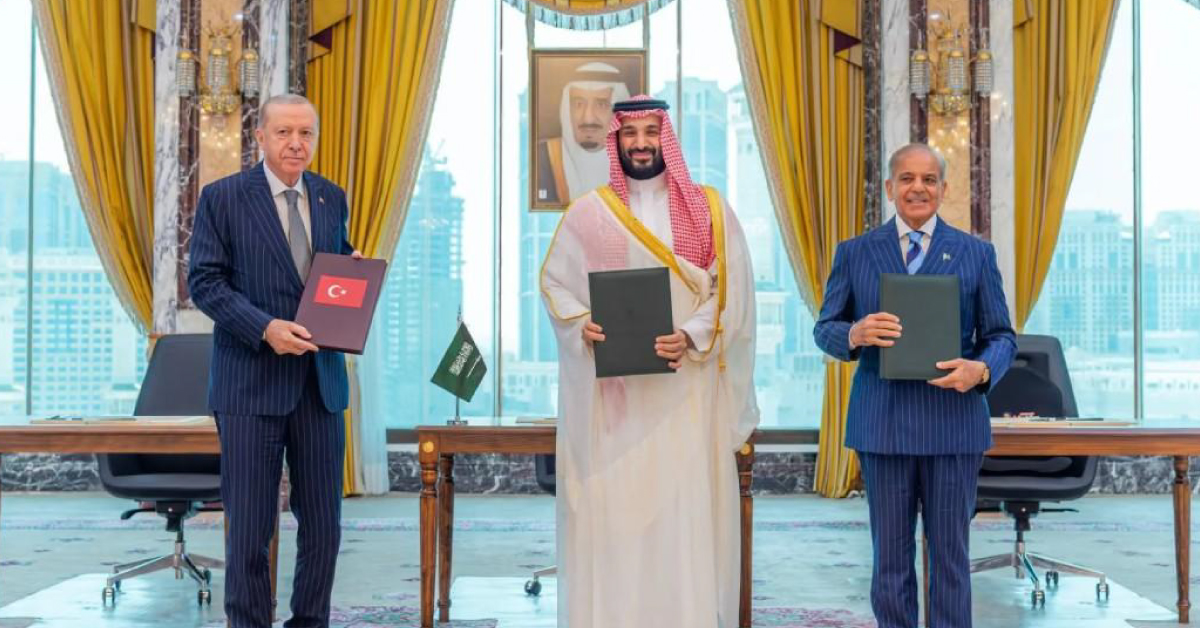
On August 7, 2026, Saudi Arabia, Tuekey, and Pakistan signed the Mecca Joint Defence Agreement. The stated objectives of the document are to strengthen collective security among the three countries, deepen defence cooperation, enhance deterrence capabilities, and promote regional peace and stability. Its key provision stipulates that an attack against any one of the three countries will be considered an attack against all three. It is this provision that has led to comparisons with Article 5 of the North Atlantic Treaty.
Turkish Foreign Minister Hakan Fidan has clarified that, in the event of an attack, the scope, nature, and format of assistance will be determined by the allies through consultations. Assistance may take various forms, ranging from intelligence and information sharing to logistical support and the deployment of military units, depending on the nature and scale of the threat. The published joint statement does not identify any specific country as a common enemy or threat. Turkey has stated that other countries may also join the alliance in the future. Egypt has officially been mentioned as a potential member, while experts have also pointed to Qatar, Kuwait, Azerbaijan, Syria, and Jordan. On August 20, 2026, the Syrian Foreign Minister announced that Damascus was considering joining the agreement. The Mecca Agreement should also be viewed in the context of the Strategic Mutual Defence Agreement signed between Saudi Arabia and Pakistan on September 17, 2025. The full text of the agreement has not been made public.
According to analysts, the main drivers behind this process are the actions of the United States and Israel in the region, particularly against Iran, as well as the declining role of the United States in the regional security architecture.
Turkey has stated that the agreement is not directed against any country, including Iran. Iran's response has been mixed: Foreign Minister Abbas Araghchi welcomed the agreement, whereas Ebrahim Rezaei, a member of the Parliament's National Security and Foreign Policy Committee, criticised it.
Any alliance formed between states pursues certain objectives, which can be broadly divided into two categories: defensive and offensive.
Defensive Alliance
The primary objective of a defensive alliance is to protect the security of its member states. In such cases, there should generally be a common and clearly identifiable source of threat. In terms of capabilities, there are theoretically two possible candidates: Israel and Iran. However, it is unlikely that either of these countries would launch direct, large-scale military aggression against one of the members of the trilateral agreement. At the same time, at the beginning of the 2026 war, Iranian drones struck Saudi Arabian territory, while on the day the agreement was signed, Riyadh was reportedly anticipating attacks by pro-Iranian forces in Yemen and Iraq.
If the main motivation behind the formation of a defensive alliance is to balance the emergence of a dominant regional power or group of states and limit its influence, no such force is currently clearly identifiable either. Theoretically, such a role could be played by a coalition between the region's two other major actors, Israel and Iran, although this is practically impossible.
The issue can also be examined within the broader context of strategic and nuclear balance. Israel already possesses nuclear capabilities, while Iran, according to some sources, was at least on the technological threshold of developing nuclear weapons prior to the war. Recent developments may further strengthen its incentives to pursue this course. Under these circumstances, Pakistan assumes particular significance as the only Muslim-majority state openly possessing nuclear weapons. The strengthening of security ties between Saudi Arabia and Pakistan can therefore also be viewed as a mechanism for indirect security assurance. At the same time, according to expert assessments, it is unlikely that Pakistan's nuclear deterrence guarantees would extend to Saudi Arabia and Turkey as well. Tuekey, for its part, could contribute to this framework through its conventional military capabilities, particularly its advanced unmanned systems, defence industry, and technological potential.
In this sense, the trilateral format may serve not only as a mechanism for direct military defence but also as an instrument for shaping the regional balance of power.
Aggressive or Proactive Alliance
The agreement may have not only a defensive but also an aggressive or proactive character, potentially envisaging the use of force against third countries, including in the context of pre-emptive or offensive operations. The three countries do not necessarily have to share the same adversary or pursue identical aggressive objectives. On the contrary, the agreement may derive its value precisely from the fact that each participant has its own distinct regional challenges, while the support or neutrality of the other parties could be of considerable importance in addressing them.
From this perspective, Saudi Arabia has unresolved security challenges in Yemen, Turkey in Syria and along its southern borders more broadly, and Pakistan in its relations with India and Afghanistan. Consequently, the trilateral defence commitment could create more favourable conditions for each party to pursue its regional policies with greater autonomy. In this context, the value of the agreement may lie less in the prospect of the three states going to war together than in each state's ability to reduce the likelihood of opposition to its actions from the other two.
This approach becomes particularly significant if the declining direct military and political involvement of the United States in the Middle East is viewed not as a temporary phenomenon but as an indication of a long-term transformation in its regional strategy.
In that case, the major regional powers may seek to assume greater responsibility for shaping a new security architecture. Saudi Arabia could do so through its financial and economic resources, Turkey through its defence industry, technological capabilities, and particularly its unmanned systems, and Pakistan through its military capabilities and, most importantly, its nuclear arsenal.
The trilateral arrangement can also be interpreted as an agreement on mutual security assurances and neutrality. In this case, its primary objective would not be to deter an external adversary but rather to prevent potential disagreements or rivalries among its members from escalating into military confrontation. The three states have different interests and spheres of influence. In this sense, the agreement could serve as an implicit guarantee of mutual neutrality, predictability, and non-aggression towards one another amid rapidly changing regional dynamics.