
“GEGHARD”
SCIENTIFIC ANALYTICAL
FOUNDATION


2026
2026
2026-09-14
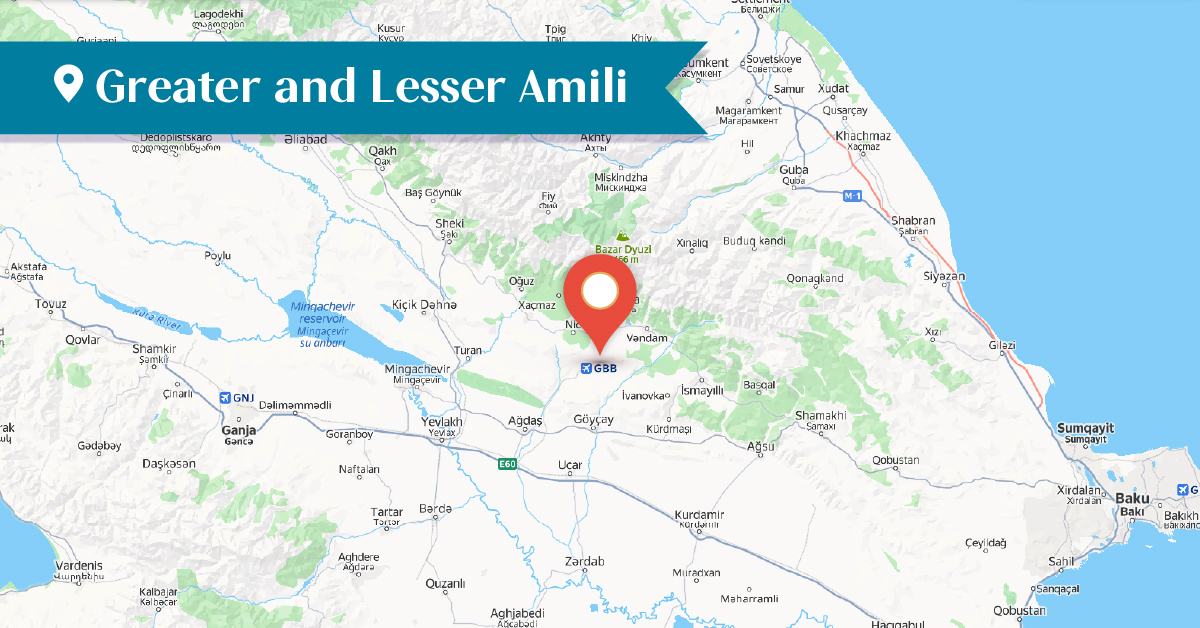
The villages of Greater Amili and Lesser Amili were among the Armenian settlements in the Kutkashen district (present-day Gabala) of Eastern Transcaucasia. Located close to one another, they lay approximately 17 km southwest of the district center, Kutkashen. Greater Amili was also known as Amulli.
The inhabitants of these two Armenian villages were forcibly converted to Islam in the second half of the eighteenth century. However, Russian sources from 1908 still identified the inhabitants of both villages as Armenians. Greater Amili had a population of 193 Armenians, while Lesser Amili was home to 33. Over time, as a result of their conversion to Islam, the local inhabitants became increasingly detached from the Armenian social and cultural environment, came to identify themselves as Muslims, and adopted the local Turkic language. By 1915, statistical records identified the inhabitants of both villages as Turks, recording a population of 250 in Greater Amili and 58 in Lesser Amili. Later, following the establishment of the Republic of Azerbaijan, the inhabitants of these villages were registered as Azerbaijanis.
There is an account that, before the inhabitants converted to Islam, a priest, Ter Daniel, from the neighboring Armenian settlement of Sultan-Nukhi, served as the priest of Greater Amili. Armenian Christian tombstones were preserved in Greater Amili and Lesser Amili for a long period. Unfortunately, today, all traces of the Armenian presence in these villages have disappeared.
Bibliography
Karapetyan, S. Aghvank Proper. The Research on Armenian Architecture (RAA) Foundation, 2024, Vol. XXII, Part 1, p. 235
T. P., “Nor-Dar,” Nor-Dar, 1889, No. 65, April 29, p. 3.
The Caucasian Calendar for 1910. Tiflis, 1909, pp. 204, 290
The Caucasian Calendar for 1915. Tiflis, 1914, pp. 99, 142.