
“GEGHARD”
SCIENTIFIC ANALYTICAL
FOUNDATION


2026
2026
2026-06-19
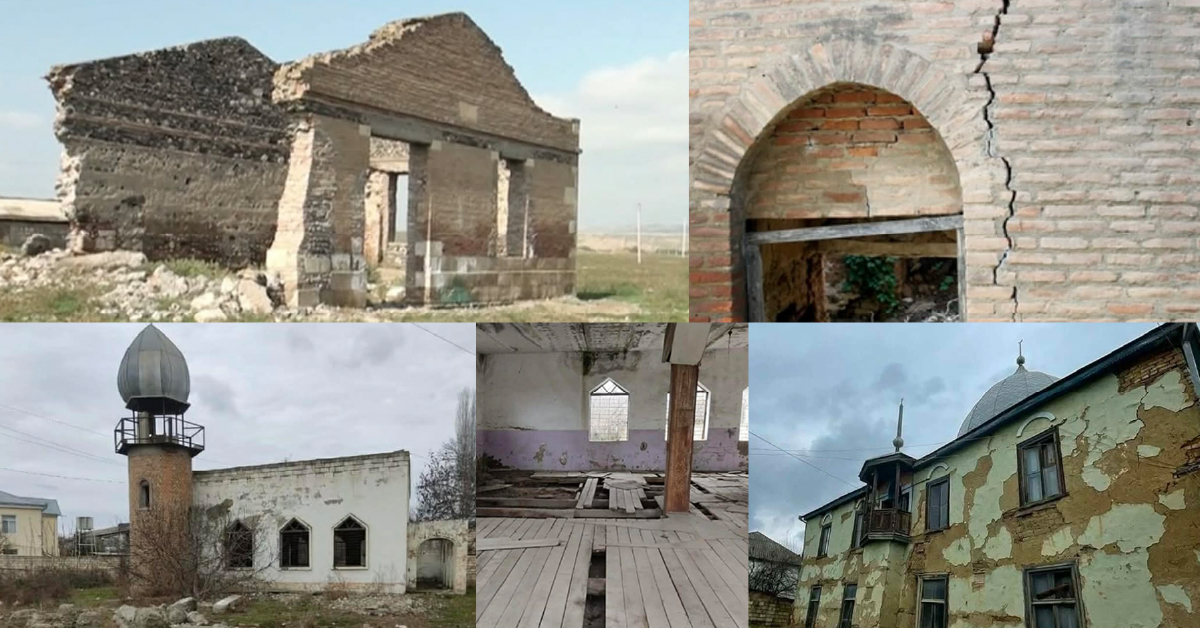
Mosques in Azerbaijan are used as cattle sheds and storage facilities: Ahmad Shahidov, head of the Azerbaijan Democracy and Human Rights Institute
In response to the statement made by the President of Azerbaijan on June 18, claiming that "Armenians kept various animals in mosques and destroyed around 65 mosques":
This statement, to put it mildly, is absolutely false. Furthermore, President Ilham Aliyev seems to "forget" to speak out about the deplorable condition of mosques in Azerbaijan itself, an issue that has been addressed by Azerbaijani experts and human rights activists, even under conditions of restricted press freedom.
Not long ago, in August 2020, Ahmad Shahidov, head of the Azerbaijan Democracy and Human Rights Institute, raised concerns that “many mosques in Azerbaijan’s villages are used as cattle sheds and storage facilities. In an Islamic country, such an approach is nothing short of godlessness.” According to the human rights activist, many mosques in Azerbaijan are in a deplorable condition. “We have many historical monuments in Ilisu, Saribash, and other villages. Due to years of neglect and indifference, these historical monuments have been deteriorating and falling into ruin,” Shahidov stated. According to him, the destruction of historical monuments in the Gakh district is the responsibility of the authorities: “Both the Gakh district executive authority and the institutions responsible for overseeing historical and cultural monuments are to blame. They are completely failing to fulfill their duties. That is why the situation has become so catastrophic. Monuments, reserves, and fortresses with a history spanning a thousand years are simply being destroyed.”
An examination of the measures undertaken to preserve mosques located in Azerbaijan indicates that they do not meet international standards.
For years, Azerbaijan has accused Armenians on various international platforms of having “destroyed” the mosques located in Artsakh. Although these cultural monuments in fact bear no connection to the so-called “Azerbaijani culture,” the Azerbaijani side continues to distort historical facts and promote misleading perceptions about Armenians in an effort to draw the attention of the international community to the issue.
The facts indicate that the so-called “cultural policy” pursued by the Azerbaijani authorities poses a direct threat to the preservation of Islamic historical and cultural heritage. Both Christian and Muslim historical and cultural monuments in Azerbaijan are at risk.
The Geghard Foundation has previously addressed the poor condition of historical monuments in Azerbaijan, as well as the challenges related to the preservation of mosques and bathhouses, and continues its series of studies on the subject.
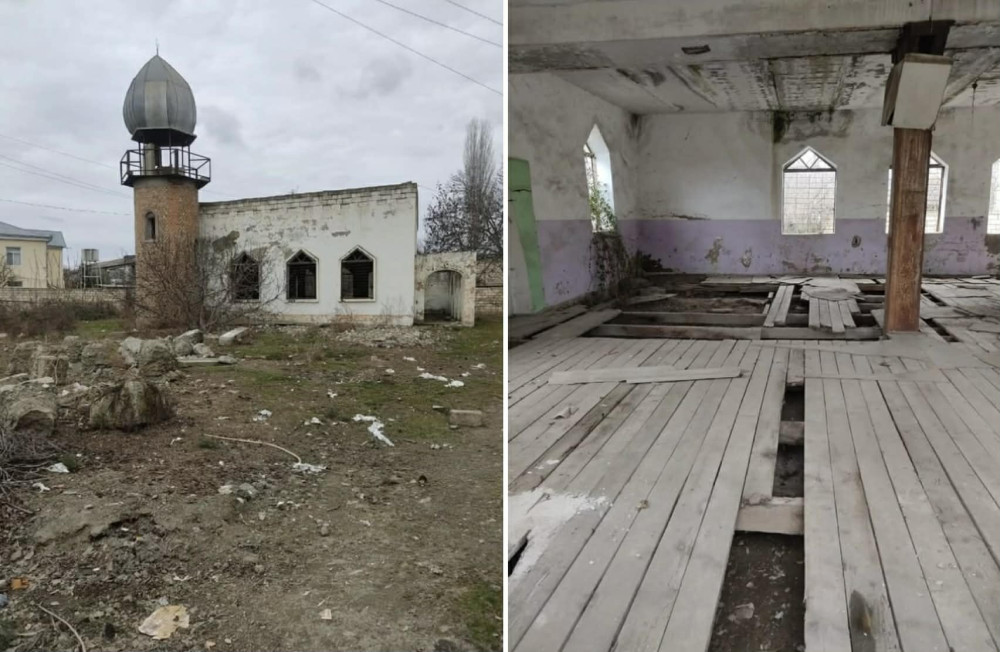
The Juma Mosque located in Khudat city of the Khachmaz district is on the verge of collapse. The local authorities, despite being aware of the mosque’s poor condition, have taken no measures toward its restoration. The mosque was built in 1993–1995 by the Kuwaiti Society for the Revival of Islamic Heritage. This piece of Muslim cultural heritage, also known as Sheikh Muhammad Yaraglı, has been closed since 2001.
According to a local resident, the mosque has turned into a shelter for drug users: “In Khudat, the mosque was closed, and the adjacent courtyard was sold. The cultural monument has been completely turned into a landfill. Inside the mosque, one can see beer bottles and syringes.
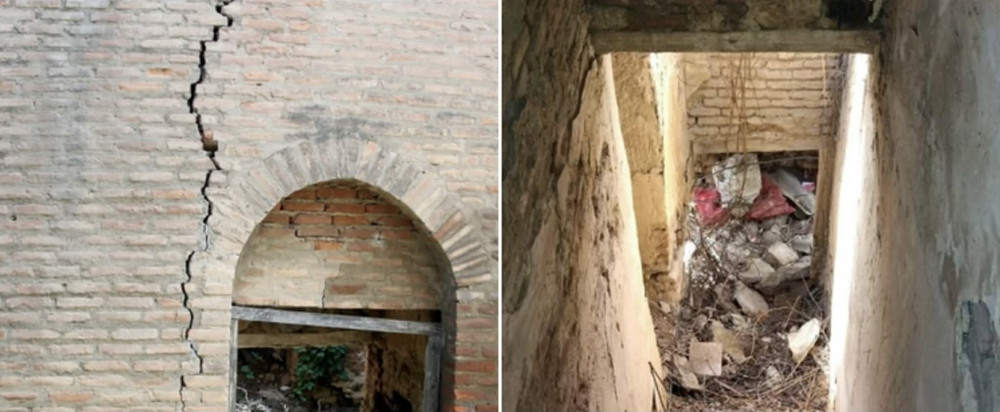
The mosque located in the village of Chinarli, Gakh district, faces a similarly precarious situation. Constructed in the 17th century, the structure underwent its most recent restoration during the Soviet period and has since deteriorated significantly. The walls exhibit extensive cracking, and the roof has fallen into a state of severe disrepair. Local residents report that despite repeated appeals submitted to the relevant authorities, no measures have been taken to ensure the preservation of this cultural heritage site. The matter was also brought to the attention of local television channels, whose representatives approached the Ministry of Culture for comment. The Ministry, however, maintained that it had received no formal applications — neither from the village residents nor from any other institutions. Through such a response, the Azerbaijani authorities demonstrate a deliberate disregard for the preservation of existing cultural heritage.
The Shah Abbas Mosque, built in the early seventeenth century, is another valuable historical monument located in the village of Yanıqlı in Azerbaijan’s Tovuz District. Due to state neglect, the mosque is now at risk of collapse. Architecturally, it resembles the Shah Abbas Mosque in Gandzak (Ganja). In 2014, the mosque’s dome collapsed completely. Although the need for restoration work was officially announced in 2022, no practical measures have been taken. According to a video published by a local resident in 2024, the mosque was in ruins. “We accuse the Armenian side, saying that Armenians destroyed our mosques, but look at the condition of this mosque. I do not know where the attention of the relevant authorities is, or what is happening in this country at all.”
Concerns about the mosque’s preservation resurfaced in 2026. Those concerned about the fate of this historical and cultural monument continued to ask a pressing question: Why has this mosque, which is more than three centuries old, not been restored?
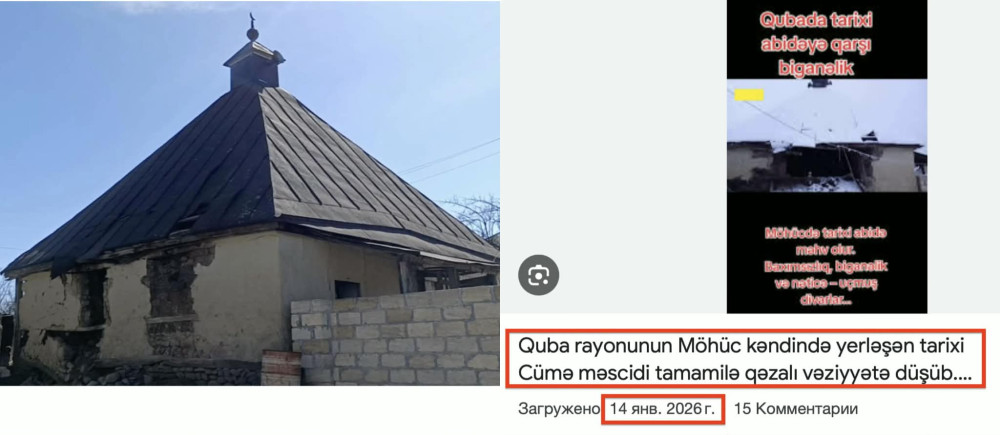
The mosque built in the nineteenth century in the village of Mohuj in the Guba district has suffered a similar fate. Although a restoration project for the mosque was approved by the Institute of History in 2022, its implementation was not permitted.
In March 2025, the State Service for the Protection, Development and Restoration of Cultural Heritage stated that the historical monument was under supervision and that inspections were planned in the near future. However, a video circulated on social media in 2026 suggests otherwise.
“The historical monument in Mohuj is being destroyed. The collapsing walls of the mosque are the result of neglect and indifference,” the footage states. It should be noted that the video has since been removed from the internet.
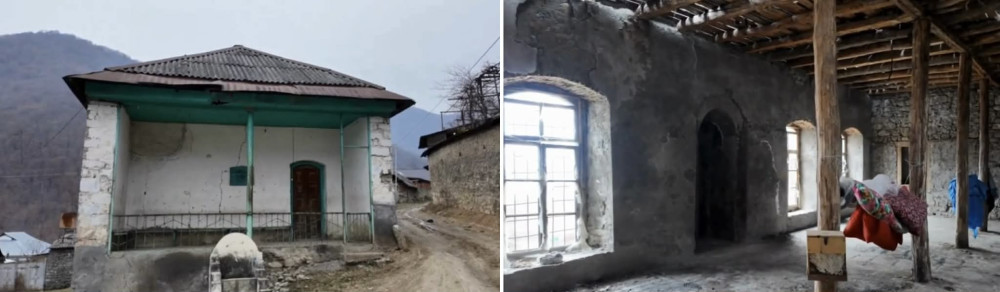
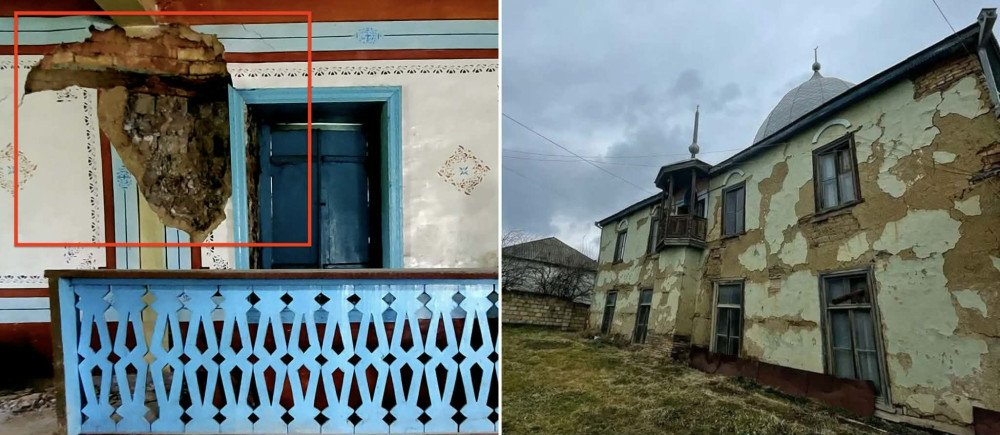
Another mosque built in the early nineteenth century is located in the village of Birinji Nugadi in the Guba District. The two-storey building is partially ruined; its walls have large cracks, and the ceiling is in a bad condition. During precipitation, the ground floor of the mosque is flooded. Local residents are attempting to address the situation by covering the roof. The use of the second floor has also been suspended due to its hazardous condition. “We pray with fear in our hearts,” said one of the local residents.
In 2020, the State Service for the Protection, Development and Restoration of Cultural Heritage under the Ministry of Culture of Azerbaijan announced that restoration works on several historical and cultural monuments were in their final stage, including the mosque in Birinji Nugadi. However, a video published in 2025 shows that no restoration work has been carried out at the mosque, and this piece of Muslim cultural heritage continues to remain at risk today.
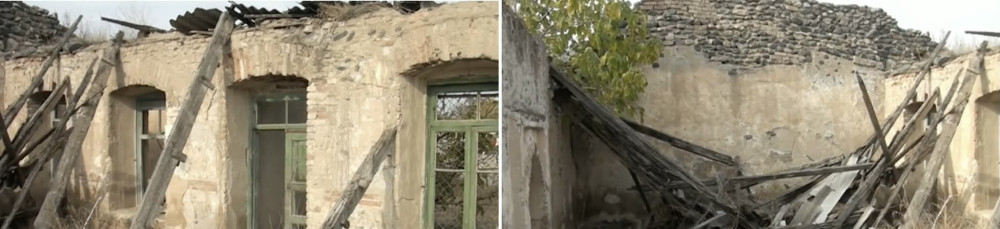
A similar situation is observed in the Aghstafa district. The ancient structures in the villages of Grakh Kasama and Ashaghi Kasama, which are about 200 years old, are on the verge of destruction.
“Look at the condition of our place of worship; all of this is painful,” said one of the residents.
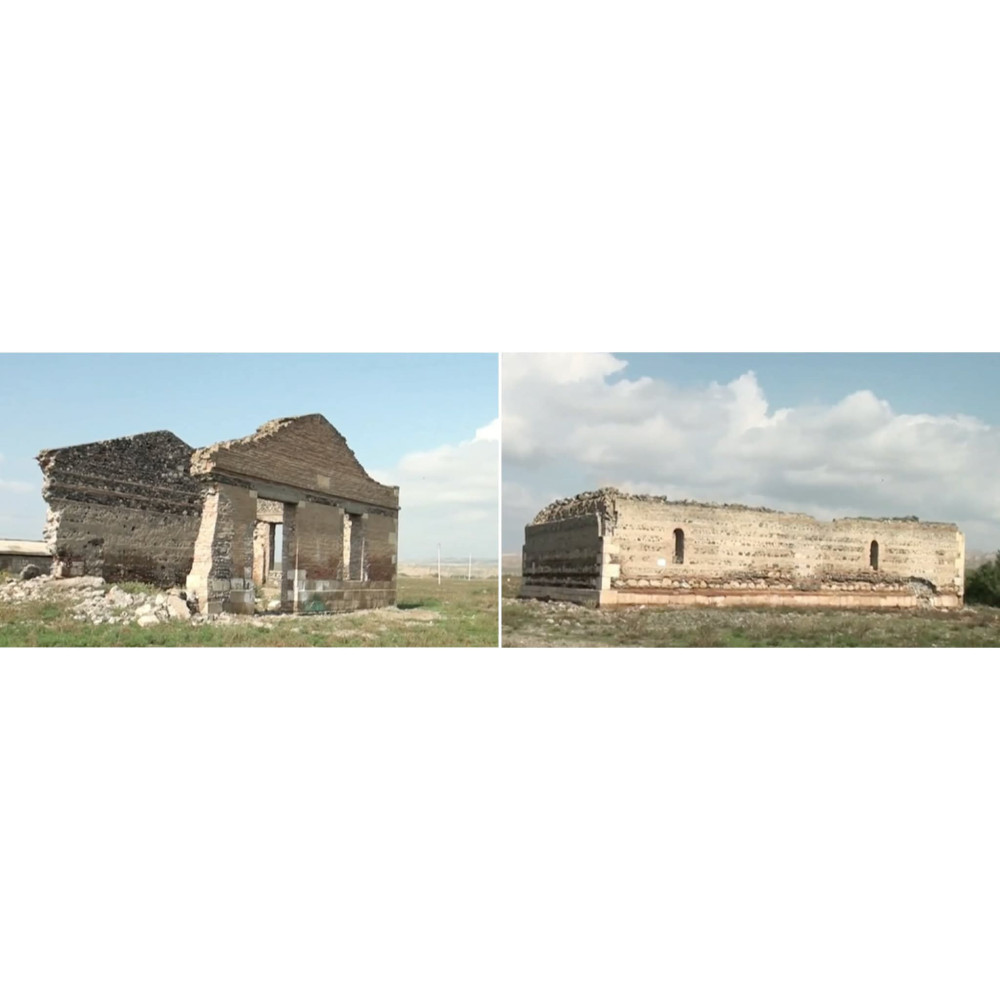
The 19th-century mosque in the village of Garahasanlı in the Aghstafa District has also fallen into ruins. “It is difficult to call it a mosque, as nothing reminding a mosque has remained here,” eyewitnesses note. The two domes of the partially ruined mosque have completely collapsed, while its doors and windows are in a dilapidated condition.
In fact, Azerbaijan has effectively declared war on Islamic civilization itself, systematically destroying the cultural and religious heritage created across different historical periods and by different peoples in the territories under its control. The self-proclaimed "multicultural" Azerbaijan has, in the 21st century, become a direct threat to the indigenous peoples of the region; the cultural and historical values created by these peoples are being deliberately destroyed or appropriated, placed in service of Azerbaijan's "identity engineering" agenda. It must be stated that the indifference of the Azerbaijani authorities toward the mosques situated within the country is further conditioned by the fact that the aforementioned cultural heritage bears no connection to the Azerbaijani state or to "Azerbaijani culture" as such.