
“GEGHARD”
SCIENTIFIC ANALYTICAL
FOUNDATION


2026
2026
2026-05-25
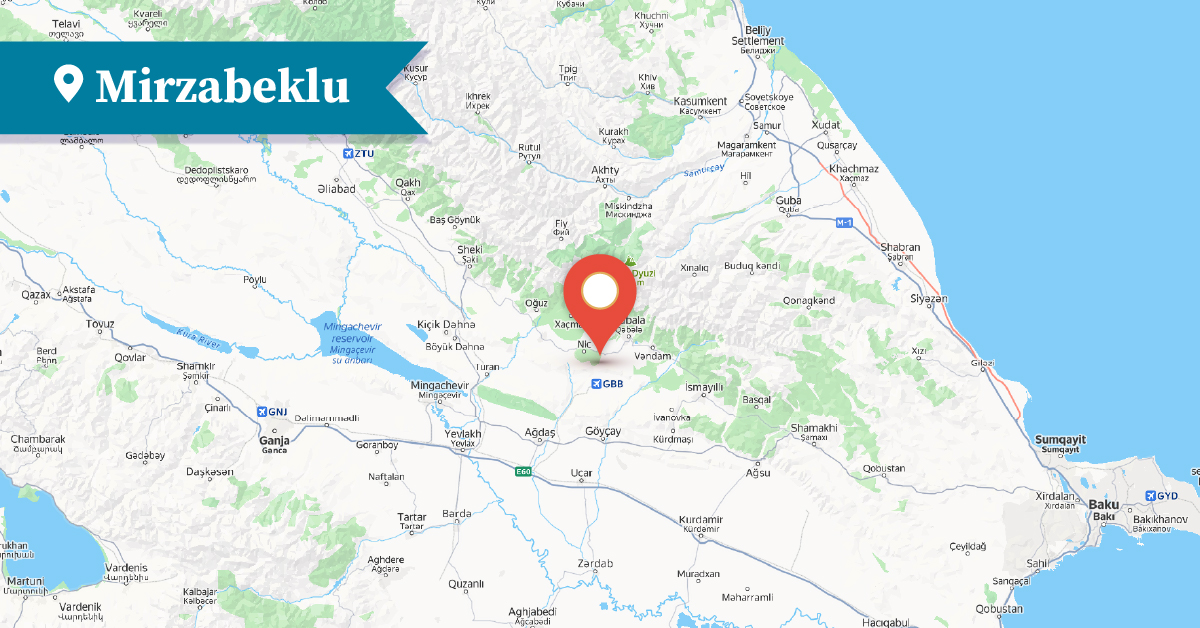
Mirzabeklu is located about 20 km from the district center of Kutkashen (Gabala). The village was also known as Mirzabaklu and Mirzabeyli. In the 18th century, the Armenians of Mirzabaklu, subjected to persecution by the khans of Shaki, shifted to the Turkic language. This was a coercion, since speaking Armenian in the Shaki Khanate during that period was dangerous. Nevertheless, the Armenians of Mirzabeklu preserved their faith.
The Surb Astvatsatsin (Holy Mother of God) basilica church of Mirzabeklu was probably built in the 19th century. The village did not have a resident priest; instead, religious services were usually conducted by itinerant preacher. Among the priests who served the community were Martiros Hakhverdyants (1868), Avetik Ter-Mikayelyan (1892–1893), and Hambardzum (Daniel) Ter-Avagyants (1898–1912). Armenian-inscribed tombstones were preserved in the village cemetery, and during his visit to Mirzabeklu in 1984, Samvel Karapetyan documented these inscriptions.
Khachi Hakobyan-Sargsyants of Mirzabeklu is buried in this grave. Whoever comes upon it, let him say: ‘May God be merciful.’ 1869.
The body of Hovsep Markosyan-Sargsyants of Mirzabeklu is buried here, 1870.
Sahak of the Saginyants family, son of Hakob is buried in this grave. We ask the passerby to read with faith: God is merciful to the departed soul. March 15, 1897, village of Mirzabeklu.
Balasan, daughter of Ter Daniel of the Ter-Avagyants family, is buried here, 1899.
Vardan, son of Minasyan, of the Petiyants family is buried in this grave. He died on December 28, 1909.
Oganov Yeghish Margari, 1873–1962. In memory from his wife Vard, daughter Amalya, and nephew Avetis.
In 1841, Mirzabeklu had 251 Armenian inhabitants; by 1876, the population had increased to 283. In 1901, the village was home to 343 Armenians, in 1908 to 412, and in 1914 to 361 inhabitants.
Interestingly, during this period the village had its own rural court. One of its judges was mentioned as a “Turkic-speaking Armenian Christian villager, a well-known wealthy man and benefactor, village judge (sudya) Sahak Saginean.”
In the second half of the 19th century and the beginning of the 20th century, the village was part of the Nukha district of the Elizavetpol Governorate. In 1918, the Armenian population of the village also suffered from Turkic-Tatar attacks. In 1919, the Azerbaijani authorities settled families of Caucasian Tatars there. Later, Lezgins also settled in the village.
The Armenians of Mirzabeklu continued to live in the village until 1988–1989, when, as a result of the genocidal policies of the Azerbaijani authorities, they too were forced to leave their native village.
Bibliography
Barkhutaryants M. The Land of Aghvank and Its Neighbors. Artsakh. Yerevan, 1999, p․ 126․
Karapetyan S., “The Turkic-Speaking Armenian Villages of the Kapaghak District of Historical Armenia,” Lraber Hasarakakan Gitutyunneri (Herald of the Social Sciences), 1988, no. 1, pp. 49–51.
Karapetyan S. Armenian Inscriptions of Proper Aghvank, Book I. Yerevan: NAS RA “Gitutyun” Publishing House, 1997, pp. 40-41․
Karapetyan S. Aghvank Proper, Research on Armenian Architecture Foundation, 2024, Book 22, part 1, pp. 265-270.
Pek, “Nor-Dar,” 1893, No. 95, June 5, pp. 2–3.
Ghazaros Priest Hovsepents, “Letter to the Editorial Office,” Nor-Dar, 1890, No. 70, June 1, p. 2.
Kavkazskiy Kalendar for 1910, Tiflis, 1909, p. 321.
Kavkazskiy Kalendar for 1915, Tiflis, 1914, p. 158.