
“GEGHARD”
SCIENTIFIC ANALYTICAL
FOUNDATION


2026
2026
2026-04-13
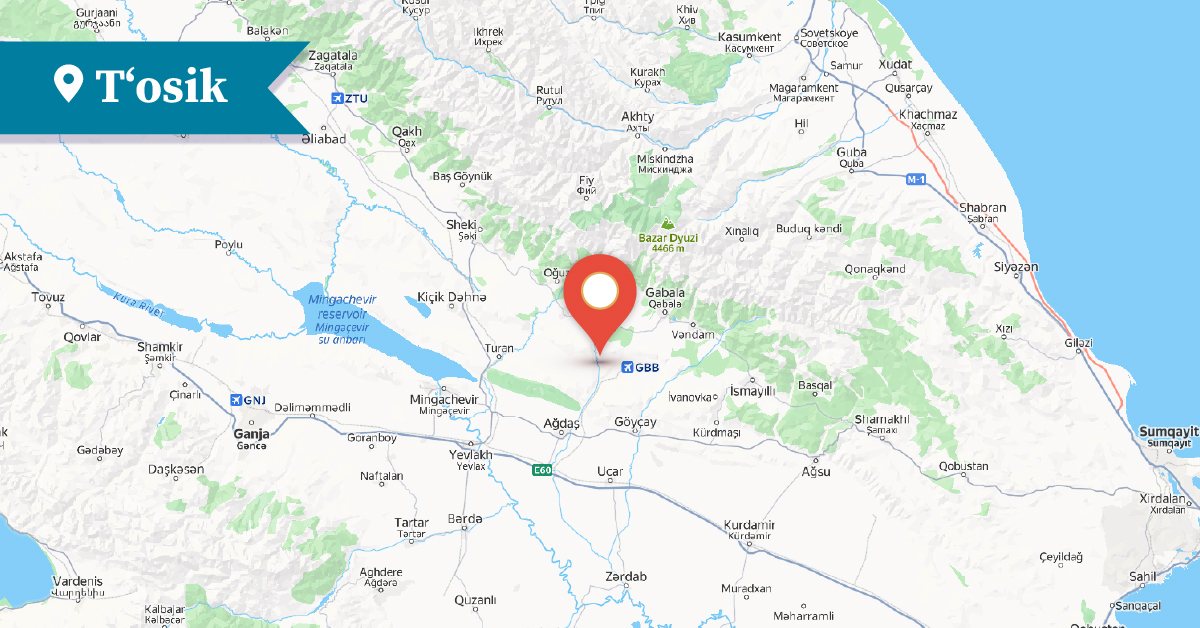
Tʻosik was one of the Armenian villages of historical Caucasian Albania. It was located 22.7 km southwest of the present-day administrative centre of Gabala (Kutkashen).
The first mentions of the village date back to the 18th century. According to preserved information, the inhabitants of Tʻosik settled there in the 18th century, having migrated from the Khachen and Varanda districts of Artsakh.
There is a record that in 1725, “Vardan of Tʻosik” signed a petition addressed to the Russian Emperor Peter the Great, composed by representatives of several villages of the Kapaghak district.
In 1841, Tʻosik had 126 Armenian inhabitants; in 1851 - 147. According to data from 1876, the Armenian population reached 143 people, and in 1889 it was 132. In 1901, the village had 125 Armenians, and by 1914 the population had increased to 156.
It is known that in the 1880s, the inhabitants of Tʻosik moved about 2 km south from the old village and founded a new village with the same name. In the old village stood the Surb Yeghishe Church, built in the 19th century. In the new village, they built a new church named Surb Astvatsatsin (Holy Mother of God).
In 1918, Ottoman troops that invaded the region and local Tatars destroyed the village, and it ceased.
Bibliography
Barkhutaryants, M. The Land of Aghvank and Its Neighbors. Artsakh. Yerevan, 1999, p 114.
Karapetyan, S. Aghvank Proper, Research on Armenian Architecture Foundation, 2024, Book 22, Part 1, pp. 257-258
Mazhak, “Materials Concerning the Utians,” Meghu Hayastani, 1881, No. 123, July 1, p.
G. A. Ezov, Relations of Peter the Great with the Armenian People, St. Petersburg, 1898, pp. 427–428.