
“GEGHARD”
SCIENTIFIC ANALYTICAL
FOUNDATION


2026
2026
2026-10-27
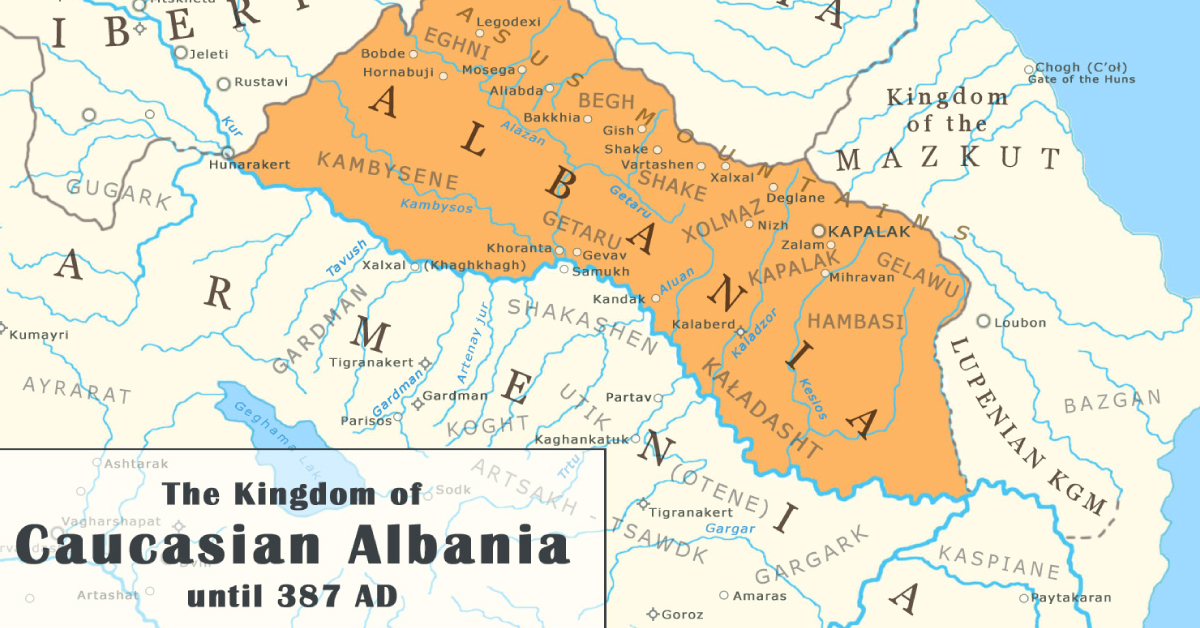
The Caucasian Albanians (also known as the Arani, Heri, Albanii, and Άλβανίοι) were a relatively small ethnic community that had been the northeastern neighbor of historical Armenia, or Greater Armenia, since ancient times and maintained friendly relations with the Armenians. The successor peoples of the Caucasian Albanians continue to live in their ancestral homeland in the northern part of the eastern South Caucasus (the territory of the present-day Republic of Azerbaijan) and in the adjacent southern part of Dagestan (Russian Federation), extending from north of the Kura River to the Derbent Pass and the Caspian Sea.
According to Strabo, the 26 tribes of Caucasian Albania inhabiting this territory, whose languages belonged to the Northeast Caucasian language family, united to form a single kingdom around the beginning of the first century BCE. Christianity was proclaimed the official religion of Caucasian Albania in the early fourth century. The Albanian Church, established during this period, adhered to the doctrine of the Armenian Apostolic Church, while the Catholicoi of Albania recognized the supremacy of the head of the Armenian Church.
The independent kingdom of ancient Caucasian Albania, with its capital at Kapaghak–Kabala, existed until the fifth–sixth centuries CE and was subsequently re-established for a brief period in the ninth–tenth centuries.
The process of ethnic consolidation among the 26 tribes of Caucasian Albania was accompanied by complex developments that unfolded in several stages. In the first half of the fifth century, Sasanian Iran brought the South Caucasus under its control, incorporating into the Albanian marzpanate both Albania Proper, located on the left bank of the Kura River, and the northeastern Armenian provinces of Artsakh and Utik, which were part of Greater Armenia.
At that time, the process of ethnic consolidation among the Albanian tribes had not yet culminated in the formation of a unified ethnic group and had stalled at the level of a meta-ethnic, or collective, community. For several centuries, until the High Middle Ages, the northern (Caucasian Albanian) and southern (Armenian) parts of the marzpanate, which came to be known as Albania (Arran in Persian), followed the same course of administrative and political, social, and cultural development.
The script and written culture of the Caucasian Albanians, developed in the 420s through the collaboration of Mesrop Mashtots and Benjamin, an Albanian cleric, experienced relatively limited growth. This was particularly evident in the sixth century, when the political and religious centers of the Albania–Arran administrative unit were relocated to the right bank of the Kura River, into Armenian-populated territories, where the city of Partav was founded. Thereafter, the cultural development of the Christian population of Caucasian Albania proceeded primarily under the influence of Armenian written culture and within the framework of the traditions it had established.
Since a unified ethnic group had not yet emerged from the multi-tribal Albanian community in the early Middle Ages, the Armenians living on the right bank of the Kura River understood the term “Albania” as the name of their own homeland, also referring to it as the Eastern Regions of Armenia, meaning the eastern territories of Armenia. Clearly, this was merely a transfer of the geographical designation and could in no way alter the ethnic composition of the Armenian region.
According to the fifth-century historian Movses Khorenatsi, the inhabitants of the four principalities on the right bank of the Kura River descended from the progeny of Hayk, the legendary forefather of the Armenians, and thus unequivocally possessed an Armenian ethnic identity.
During the spread of Islam in eastern Transcaucasia and the adjacent regions under the rule of the Arab Caliphate, the part of the Caucasian Albanian community that remained Christian consolidated into a distinct ethnic group by the end of the ninth century, known as the Udis (also called Utis). Meanwhile, the overwhelming majority of the part of the Albanian community that had converted to Islam coalesced into an ethnic group known by the endonym Lezgins.
The western part of the Christian Albanian population, Hereti, became part of the Georgian state during the High Middle Ages, and Orthodox Christianity also spread throughout the region. In the eastern, Muslim-populated part of Albania (Shirvan), the Persian language spread, eventually giving rise to a new people known as the Tat people. At the same time, as a result of the invasions and establishment of control by various Turkic tribes, part of the local population became Turkic-speaking. In the remaining regions of historical Albania, Armenian became the language of written culture and religious rites among the Christian Udi-Albanians.
The first half of the eighteenth century marked a tragic period in the historical fate of the Udi-Albanians. During this time, Haji Chalabi Khan of the Shaki region compelled the Christian population of dozens of Udi villages to convert to Islam. Subsequently, most Muslim Udis came to identify themselves as Lezgins or Turkic Tatars. Christian Udis survived in only a few settlements, the best known of which are Nizh and Vardashen. In the early twentieth century, their number was augmented by the village of Zinobiani-Oktomberi in Georgia’s Kakheti region, founded by a group of Udis who had migrated there. Today, the Udi population is estimated at approximately 10,000 people.
The Udi-Albanians, who bear Armenian surnames and have developed their spiritual lives primarily through Armenian-language written culture, have shared with the Armenians all the tragic events that took place in the Republic of Azerbaijan in the early and late twentieth century. In late 1988, they were entirely expelled from their ancestral homeland alongside the Armenians, relocating to Central Asia, Russia, and Armenia. The following year, after receiving assurances from the Soviet authorities, some Udis returned to the settlements of Nizh and Vardashen (renamed Oghuz). However, they found themselves in a situation akin to that of hostages: the Azerbaijani authorities use them in pursuit of their anti-Armenian policies.
Under pressure from the authorities, the Udis have participated in various fabricated, anti-Armenian events. The Azerbaijani authorities seek to demonstrate that the Udis claim Armenian historical and cultural heritage, Armenian churches, and other monuments on the left bank of the Kura River, in the territory of the Republic of Armenia, and in other historical Armenian regions, extending as far as Akhtamar and Cilicia. Outside Azerbaijan, Udi-Albanians find it easier to preserve their culture, including their spoken language, and continue to speak of their centuries-old friendship with the Armenian people.