
“GEGHARD”
SCIENTIFIC ANALYTICAL
FOUNDATION


2026
2026
2026-10-16
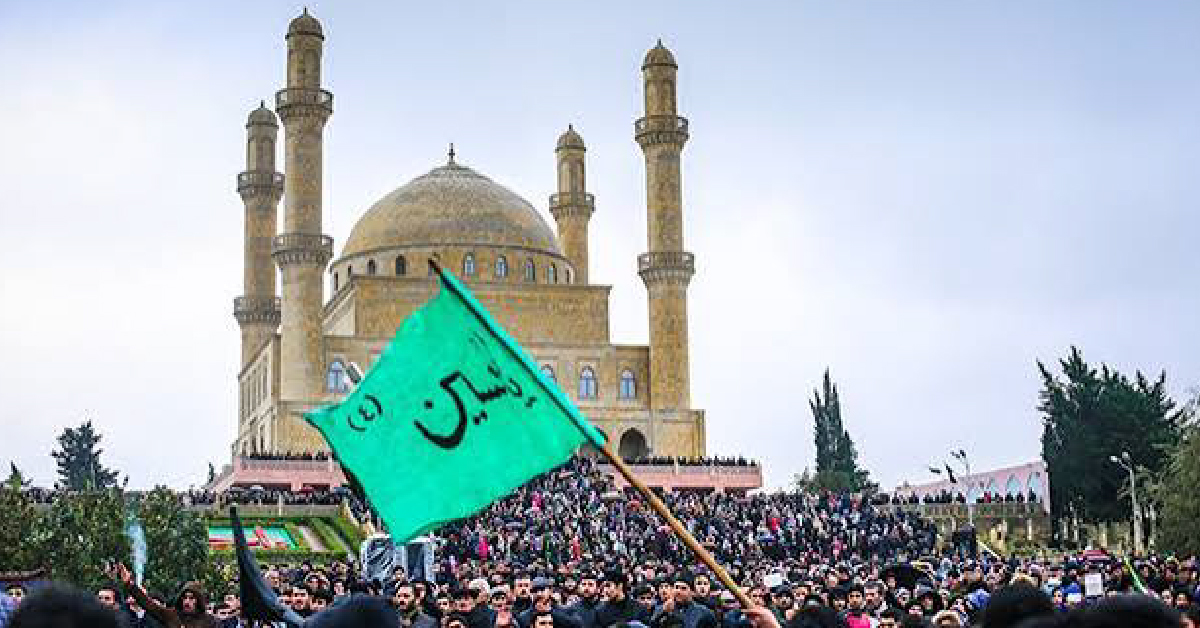
Nardaran is one of Azerbaijan’s best-known religiously conservative Shiite settlements, with a population of approximately 8,000–10,000. It is located on the Absheron Peninsula, not far from Baku. The overwhelming majority of its population are Shiite Muslims, and a significant proportion of women wear headscarves. Shiite symbols and flags have been widespread in Nardaran, and local population actively participated in the Shiite religious rites and ceremonies. The Islamic Party of Azerbaijan, which had a pro-Iranian orientation, was founded there in 1991, and its activities were banned in 1995. Iranian influence, channeled through Shiism, contributes to Nardaran’s particular sensitivity. Against this backdrop of pro-Iranian sentiment, there have also been incidents involving the burning of U.S. and Israeli flags, although such acts do not reflect Azerbaijan’s official foreign policy.
Nardaran’s religious significance can also be partly explained by its status as an ancient pilgrimage site. This religious and historical context helps explain, to some extent, why this particular settlement, unlike Azerbaijan’s other Shiite communities, became a symbol of opposition to the state. As early as June 2002, the first mass protests took place in Nardaran, although the immediate causes of the protests were poor social conditions and high unemployment.
Tensions between Nardaran’s Shiite community and the Azerbaijani authorities reached their peak on November 25–26, 2015, when Azerbaijani law enforcement agencies carried out a special operation against members of the “Muslim Unity” movement, which had been established in January 2015 and was designated by the authorities as an “armed religious extremist group.” As a result, seven people, including two police officers, were killed, and more than 70 people were arrested. In January 2017, 18 of those arrested were sentenced to between 10 and 20 years in prison on charges including terrorism, the creation of illegal armed groups, murder, and possession of weapons.
Amnesty International described the proceedings as a “miscarriage of justice,” pointing to procedural violations and credible allegations of torture against detainees. In a number of separate cases, the European Court of Human Rights has found violations of human rights by Azerbaijan. Local human rights defenders consider those arrested to be political prisoners.
Following the “Nardaran incident,” state control was tightened: the activities of clerics educated abroad, particularly in Iran, were restricted, the public display of religious symbols was curtailed, and state oversight of mosques was strengthened.
The political situation became even more complex in 2025–2026. Against the backdrop of the Iran–US–Israel war, as well as recurring tensions in Iran–Azerbaijan relations, the risks of persecution of Muslim activists in Azerbaijan have also increased. According to human rights defenders, the cases brought against them have involved a range of charges, from terrorism-related offenses to drug trafficking, which human rights organizations have described as fabricated or unfounded.
One of the recent developments concerning Nardaran has been the construction of a casino near the settlement. This can be interpreted both as a form of state pressure on religious practices and as a disregard for the community’s religious sensitivities. Moreover, during the construction of the casino the land belonging to residents was appropriated. The casino’s operation, which is associated with the Sea Breeze resort linked to Emin Agalarov, the former son-in-law of President Ilham Aliyev, can also be viewed in the context of the tensions that have developed between secular Azerbaijan and religious Nardaran. Casino operations were legalized through legislative amendments adopted in July 2025, which limited their location to artificial islands in the Caspian Sea. Some experts view the casino’s location as a means of symbolically transforming the area, potentially reshaping Nardaran’s socio-cultural environment from a pilgrimage site into a center of entertainment.
The legality of the land expropriations was challenged in court. On February 18, 2021, in the case of Ganiyeva and Others v. Azerbaijan, the European Court of Human Rights ruled that the decision of the Baku City executive authority to transfer the gardens leased by the applicants to the municipality of Kurdakhani and subsequently sell them to a private company was unlawful. The Court awarded each of the 18 applicants €13,000 in compensation, amounting to a total of €234,000. Nardaran was not mentioned in the judgment.
Another, more striking incident took place on July 20–21, 2026, during Azerbaijani President Ilham Aliyev’s official visit to Germany. According to available reports, Alamdar Bunyatov, a Nardaran native living in Germany, encountered Foreign Minister Jeyhun Bayramov and presidential aide Hikmat Hajiyev, who were accompanying Aliyev, on the street. Bunyatov, a former resident of Nardaran and a former member of the Islamic Party of Azerbaijan, has been granted political asylum. He followed the Azerbaijani officials and confronted them with accusatory questions.
What matters most is not so much the substance of the incident—the questions raised and the answers given—as its symbolic significance. The incident demonstrates that the issue that emerged in Nardaran nearly a decade ago has also acquired a political presence abroad. In this context, Bunyatov acts not merely as an individual opposition figure but also as a bearer of Nardaran residents’ grievances and the political memory of these events. Through him, an issue that had long been suppressed within Azerbaijan’s domestic political system has entered the European public sphere.
At the same time, the questions and issues raised by Bunyatov were not limited to Nardaran but also addressed the broader human rights situation in Azerbaijan. On the other hand, the calm demeanor of the Azerbaijani officials is noteworthy and can be viewed as an expression of the Azerbaijani authorities’ external communication strategy, aimed at demonstrating that the government is prepared to respond to opposition allegations even in an international public setting. This is particularly significant in light of the incident that took place in Washington in February 2026, when President Ilham Aliyev’s bodyguards assaulted Azerbaijani opposition figures, triggering widespread public reaction and sharp criticism.
In turn, pro-government media also addressed the Nardaran issue in April 2026, linking it to Iranian interference. These reports claimed that Iran’s religious authorities had attempted to turn Nardaran into a “religious canton” by supporting the formation of the “Muslim Unity” movement in Azerbaijan. According to the same source, the movement had sought to change Azerbaijan’s constitutional order. Pro-government media use expressions such as “ties with Iran,” “Iranian influence,” and “links to Iranian intelligence services” to characterize Bunyatov. The official narrative also draws on the July 2018 assassination attempt against the head of the Ganja city administration and the unrest that followed, which Baku attributes to a group known as “Huseyniyyun,” formed in Iran.
This incident is presented by Baku as the main justification for claims that Iran has been building destabilizing networks in Azerbaijan. At the same time, independent observers and activists associated with Nardaran question the thesis of Iran’s “direct control” over the situation, emphasizing that the local population’s religious conservatism has predominantly local and historical roots and cannot be attributed entirely to external interference. In other words, the three most recent developments—the construction of the casino, the Berlin street encounter, and the coverage by pro-government media—indicate that in 2025–2026 the Nardaran issue has continued to feature in the context of Azerbaijan’s domestic politics and its relations with Iran, across diplomatic and religious-symbolic, propagandistic, and economic dimensions.
At the same time, the incident encompasses a range of interconnected issues involving political exile, religious identity, and resistance to state control. Overall, Nardaran continues to serve as a symbolic “illustrative case” in the context of both the Azerbaijani authorities’ secularism and security policies and the sensitivities surrounding Baku–Tehran relations. Any escalation in Iran–Azerbaijan relations, such as the drone strike on Nakhichevan Airport on March 5, 2026, is immediately reflected in domestic security policies, particularly those concerning Shiite religious communities.
Although Nardaran largely lost its former significance as a center of religious and political resistance following the “Nardaran events” of 2015, it continues to retain its symbolic role today.
Therefore, any tensions in Iran–Azerbaijan relations could once again “reignite” the issue of Shiism in Nardaran—not only within Azerbaijan itself, but also among the opposition diaspora, where it may become intertwined with broader concerns over human rights in Azerbaijan.