
“GEGHARD”
SCIENTIFIC ANALYTICAL
FOUNDATION


2026
2026
2026-09-18

The director of the Baku-based think tank Baku Research Institute, historian Altay Goyushov, recently exposed one of the fabrications of Azerbaijani propaganda on his X account.
Goyushov responded to a post by Magdalena Grono, the EU Special Representative for the South Caucasus and the crisis in Georgia, on her official page. According to the post, on September 11–12, the EU Special Representative participated in a visit organized by the Azerbaijani authorities for members of the diplomats to the “former conflict-affected regions of Karabakh and Eastern Zangezur” in order to familiarize themselves with the situation on the ground.
What is particularly noteworthy is that, in his response, Goyushov emphasized that no one in the history of Azerbaijan had referred to the region as “Eastern Zangezur.” In effect, the term was introduced into public circulation by President Ilham Aliyev immediately after the 2020 war.
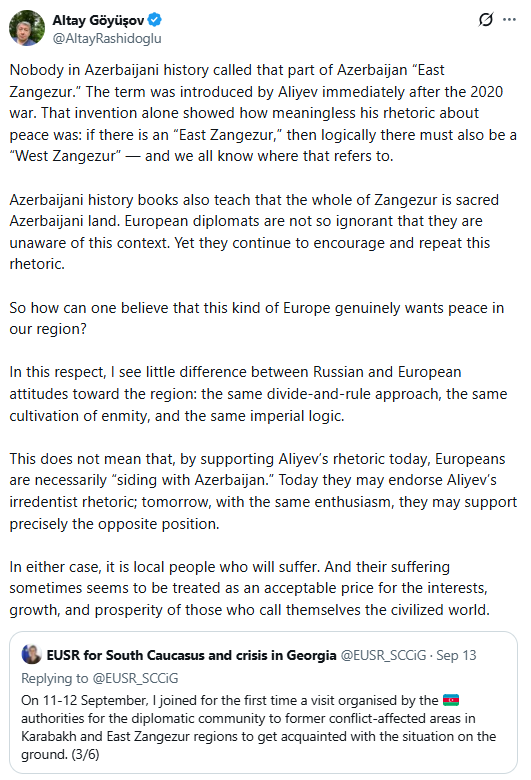
The historian even mocked the “term,” calling it Aliyev’s “invention.” Emphasizing that the use and promotion of the term itself contradicts the rhetoric of peace, Goyushov stated: “How can Europe, which encourages such rhetoric, sincerely wish to see peace in the region?”
It should be noted that Goyushov has on occasion made statements critical of the Aliyev administration, making him a target of the Azerbaijani authorities. In 2025, Goyushov was sentenced in absentia to six years in prison by a court in Azerbaijan’s Binagadi district on charges of making “anti-state public calls” under Article 281.2 of the Criminal Code.
Goyushov is not the only Azerbaijani scholar to have condemned such fabricated propaganda narratives. For example, another Azerbaijani historian and conflict studies scholar, Arif Yunus, who lives in exile in the Netherlands, has similarly addressed the so-called “Western Azerbaijan” terminology. Yunus was previously a political prisoner because of his critical articles on the policies pursued by the Azerbaijani authorities. In his view, the “Western Azerbaijan” narrative is a political and propaganda tool.
Even more noteworthy is the fact that Turkish experts have also condemned these manifestations of Aliyev’s propaganda. Turkish political scientist Cengiz Aktar has likewise criticized the use of the term “Western Azerbaijan.” In one of his interviews, Aktar noted that even after capturing Karabakh, Baku “did not stop” and this time introduced the term “Western Azerbaijan” into circulation, directly referring to Armenia.
Aktar has also actively discussed and criticized this phenomenon in his academic publications and professional circles.
Turkish scholar and politician Baskın Oran has also addressed the terminology used by Azerbaijan. During an interview, Oran emphasized that Azerbaijan refers to approximately 70% of the territory of Armenia as “Western Azerbaijan.” He characterized this as expansionist rhetoric, noting that the term serves as a masking device obstructing the development of Armenia–Turkey relations and aims to nullify the gains achieved in the peace process.
It is evident that the propaganda constructs “Eastern Zangezur” and “Western Azerbaijan,” created and promoted by the Aliyev administration, have no basis in historical scholarship and have been sharply criticized even by Azerbaijani and Turkish historians and scholars. This once again demonstrates the pseudoscientific and intellectually bankrupt nature of this propaganda narrative.