
“GEGHARD”
SCIENTIFIC ANALYTICAL
FOUNDATION


2026
2026
2026-08-10
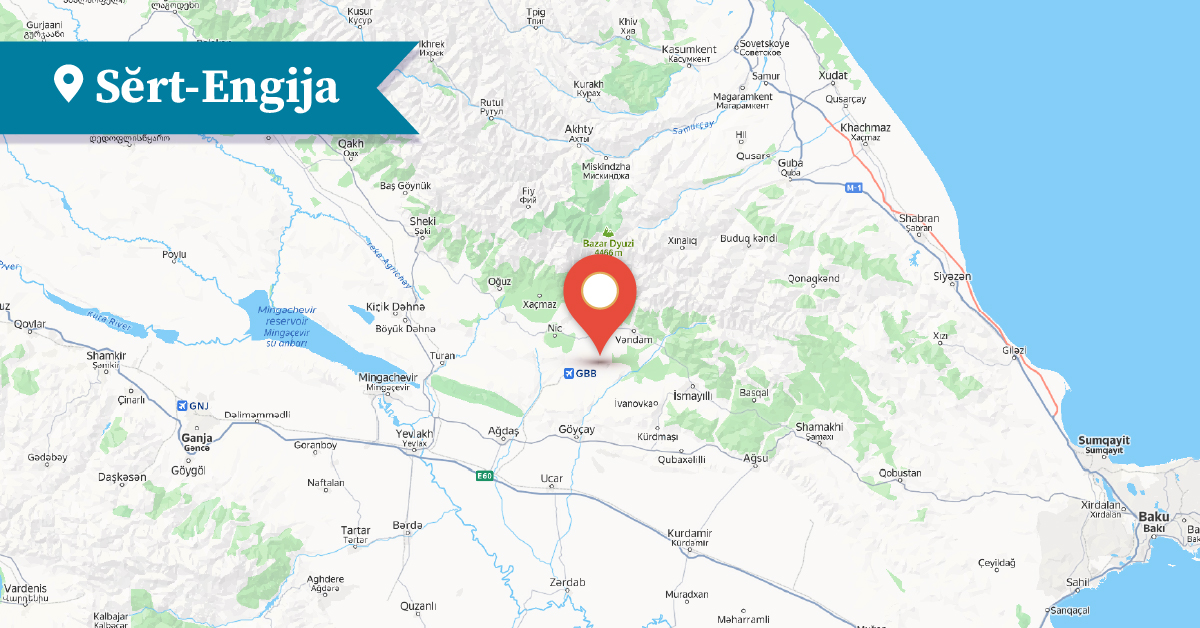
The village of Sĕrt-Engija in the Kutkashen district was located about 15 km southwest of the district center (present-day Gabala). It was also referred to as Sirtengija.
The village’s population had mainly migrated here from the Khachen, Jraberd, and Varanda districts of Artsakh.
In 1841, 141 Armenians lived in the village. By 1889, the Armenian population had reached 245. In Sĕrt-Engija, 274 Armenians lived in 1905, 229 in 1912, and 296 in 1914.
There was no school in the village, and local children attended the school in Beklarkend. Sĕrt-Engija was home to the Church of St. George, which was first mentioned in 1841. The church was served by the priest of the Armenian village of Sultan-Nukhi.
The cemetery of Sĕrt-Engija contained medieval khachkars (cross-stones) bearing Armenian inscriptions. The ethnographer Bishop Makar Barkhudaryan, recorded the Armenian writings preserved on the khachkars:
In the year HG. May God have mercy on Shoghakat.
Saint Sargis…
The following words were preserved on one of the tombstones:
Thomas, in the twelfth year.
Like other surrounding Armenian villages, Sĕrt-Engija was also destroyed in 1918, when Ottoman forces that had invaded the region, together with local Caucasian Tatars, massacred much of the Armenian population of Eastern Transcaucasia. Following these events, the village ceased to have an Armenian population.
Bibliography
Barkhutareants, M. The Land of Aghvank and Its Neighbors. Artsakh, Yerevan, 1999, pp. 113-114.
Karapetyan, S. Armenian Inscriptions of Aghvank Proper, Book I. Yerevan, 1997, pp. 43-44.
Karapetyan, S. Aghvank Proper. The Research on Armenian Architecture (RAA) Foundation, 2024, Vol. XXII, Part 1, p. 315.
Syunetsi, Correspondence, Nor Dar, 1887, No. 86, June 3, p. 2.
Alphabetical Lists of Armenian Gregorian Churches and Muslim Mosques in the Empire. Department of Spiritual Affairs of Foreign Confessions, 1886, pp. 56–57.
Caucasian Calendar for 1915. Tiflis, 1914, p. 181.