
“GEGHARD”
SCIENTIFIC ANALYTICAL
FOUNDATION


2026
2026
2026-05-08
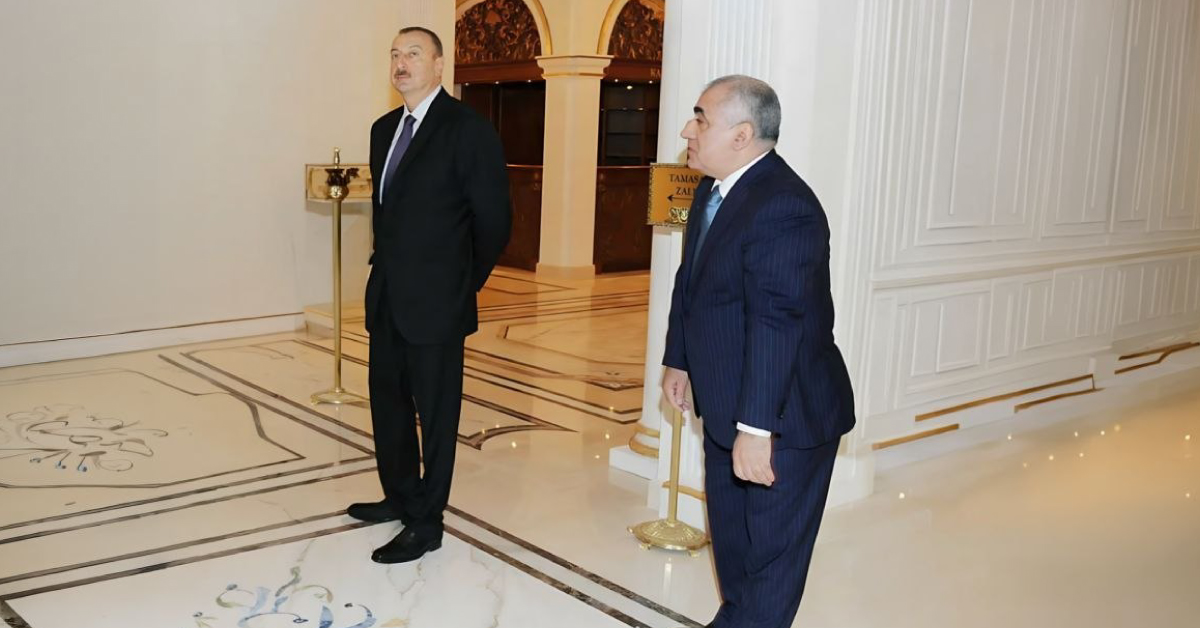
In recent days, pro-government Azerbaijani media has been publishing articles about the business empire of Ali Asadov, who has served as the country’s Prime Minister since 2019. According to an article titled “Ali Asadov’s business and construction empire,” published by one of the websites, the prime minister owns 7 buildings, 5 restaurants, and 1 hotel located in various districts of Baku.
According to the author, President Ilham Aliyev expects state officials to demonstrate professionalism, modesty, courteous conduct, and respect for the law. Officials, the article states, should not accept bribes and abuse their authority for personal gain. However, the article presents Asadov as an example of an official who has failed to follow Aliyev’s instructions.
According to Qafqazinfo, even when Ali Asadov was serving in the presidential administration, his name was already being linked to business activities.
“One of Baku’s most prominent and prestigious locations, opposite Flag Square, is home to the ‘Manqal’ restaurant, which, according to some reports, belongs to Ali Asadov. Its size and luxurious appearance make it is impossible not to notice,” the article states. Nearby is the ‘Beer Hall’ restaurant. The article notes that the two properties are estimated to be worth millions. Another “Manqal” restaurant is located in Zagulba.
Among the businesses allegedly owned by Ali Asadov are the “Narşərab” restaurant complex located in the Bibi-Heybat settlement and the adjacent “Sapphire” hotel. The Azerbaijani prime minister is also said to own the “Ocaqbaşı” restaurant operating in Bayil.
The media outlet emphasizes that “the prime minister’s salary would not have been sufficient to acquire all of this real estate.”
The list of properties associated with Ali Asadov’s name is not limited to those mentioned above. It also includes a four-story office building in the Sabayil district, a non-residential building in the Khatai district, residential houses in the Yasamal and Sabayil districts, a residential complex in the Sabunchu district, three multi-story buildings in Bayil, and other properties.
The pro-government Azerbaijani media outlet also accuses Asadov of organizing “leaks.” “Through his ‘favorite’ journalists, Ali Asadov makes public issues discussed during closed Cabinet meetings, attempting to place the blame on someone. The high-ranking official apparently fails to realize that Azerbaijan is a small country, and it is not difficult to find out who is connected to whom and who communicates with whom,” the author writes.
In general, Azerbaijani pro-government media outlets rarely dare to prepare and publish materials of this nature without instructions “from above.” Publishing such an article about Asadov without the authorities’ approval, or at least their tacit consent, is highly unlikely.
This is not the first time that pro-government, state-controlled media outlets in Azerbaijan have published articles about the corrupt activities of officials. However, such materials have usually appeared only after those officials were dismissed from their positions. Asadov, notably, has not been removed and continues to serve in office.
In that case, what is the purpose of publishing such an article?
According to experts, such publications are intended to “threaten” or “punish” the prime minister. At the same time, there appears to be an effort to reinforce in public opinion the narrative that “Ilham Aliyev is good, while those around him are bad.”
Elman Fattah, director of the Center for Caspian Studies and Analysis, believes that the publication of such articles about the prime minister in government-controlled media could only have been authorized by the presidential administration. However, he notes that it is not realistic to expect an immediate dismissal from office.
“Sometimes such leaks are simply controlled messages within a broader framework and may not lead to concrete actions. However, if the flow of such information is continuous, it may result in a shift in position or a restriction of influence. The key question is whether these revelations will continue or remain temporary,” Elman Fattah said.
Political analyst Gabil Huseynli, who previously served as an adviser to President Heydar Aliyev, emphasized that the spread of such information indicates preparations to “target” the official in question. “This practice existed during Heydar Aliyev’s time. When a person was being dismissed, public opinion was first shaped against them, and only then were decisions made regarding their case. This time, a more extensive anti-propaganda campaign is being carried out,” the former adviser added.
Former ambassador Arif Mammadov also believes that these developments signal Asadov’s possible removal from office. “Generally, there is already such a tradition in Azerbaijan: before someone is ‘targeted,’ information about their assets and critical articles about them are published in government media. Everyone understands that Ali Asadov’s time is over,” Mammadov said.
Azerbaijani opposition figure Fuad Gahramanli has also questioned why Ilham Aliyev has not dismissed Ali Asadov. Despite government-affiliated media publishing reports on alleged corruption involving Asadov, he remains in office. According to the activist, corruption has effectively been normalized at the highest level of the state.
“We wrote last time that if Ali Asadov remains in his position after these articles, it will mean that Ilham Aliyev has openly acknowledged the reality of corruption in his government. In doing so, he has once again sent a message to society that you must also accept this situation. It is also clear that in this country it is not laws and the legal system that determine who has committed a crime, but Ilham Aliyev himself,” Gahramanli noted.
However, given that the pressure around Asadov is increasing in the Azerbaijani pro-government media space, further revelations about him, or even his dismissal, cannot be ruled out in the near future. The materials circulating in pro-government media reflect an internal political struggle within Azerbaijan’s ruling elite, which in this case appears to be directed against Asadov. This situation shows that the fight against corruption in the country is selective and politicized, and that decisions are driven not by law but by the balance of power within the ruling establishment.