
“GEGHARD”
SCIENTIFIC ANALYTICAL
FOUNDATION


2026
2026
2026-03-30
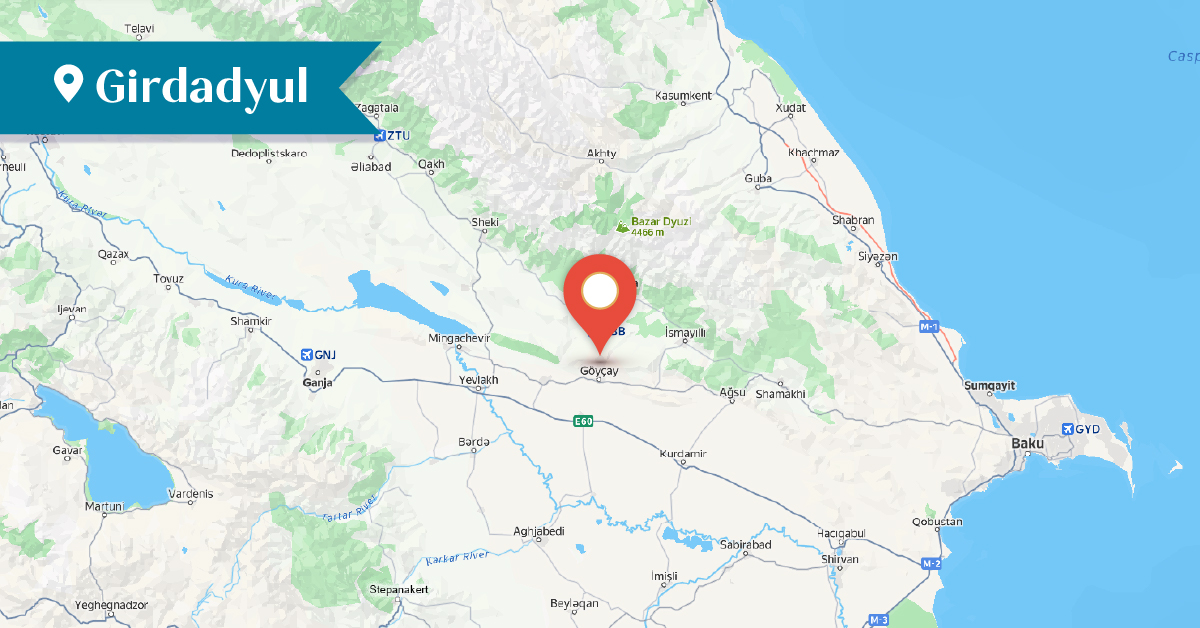
The village of Girdadyul is located 27.3 km southwest of the present-day administrative center of Gabala (Kutkashen). The settlement was also been known as Girtatul.
Armenians had lived in the village since ancient times. In the late 18th century, Armenians from the Khachen and Varanda districts of Artsakh also settled there. Unlike a significant portion of the Armenian population in the villages of the region, the inhabitants of Girdadyul did not renounce Christianity or convert to Islam in the 18th century.
According to the data of 1841, 235 Armenians lived in the village of Girdadyul; in 1851 the number reached 532, and in 1889 it increased to 985 Armenian residents. In 1905 the Armenian population of the village reached 1,034, and in 1918 it was 1,065.
The Surp Astvatsatsin (Holy Mother of God) Church in the village was known at least from the 18th century. According to the topographer Bishop Makar Barkhutaryants, a construction inscription had been preserved with the following content:
“This church of Surp Astvatsatsin was built by the community of Girdadyul in 1881.”
Among the tombstones discovered in the village cemetery, two inscriptions have been recorded, dating to the 17th century:
“God have mercy on Solomon, 1654.”
“Ovanes, 1699.”
Near the village there was also a partially ruined fortress, known as Jragogh.
The events of 1918 were fatal both for the village of Girdadyul and for the entire Armenian population of Eastern Transcaucasia. Ottoman troops that had invaded the region, joining with local Turkic forces, massacred the Armenian population of the area.
In July 1918, the inhabitants of Girdadyul were forced to relocate to the Armenian village of Vank, where—together with Armenians who had taken refuge there from other Armenian villages—they resisted the Turkish-Tatar forces for four days. However, the majority of the Armenian population of Girdadyul was massacred in the summer of 1918.
Bibliography
Barkhutaryants, M. The Land of Aghvank and Its Neighbors. Artsakh. Yerevan, 1999, p․ 112, 119.
Grigoris v. Ter-Hakobents. Nukhi. Meghu Hayastani, no. 94, December 6, 1880, p. 3.
Karapetyan, S. Armenian Inscriptions of Proper Aghvank, Book I. Yerevan: NAS RA “Gitutyun” Publishing House, 1997, p․ 39, 40.
Karapetyan, S. Aghvank Proper, Research on Armenian Architecture Foundation, 2024, Book 22, Part 1, pp. 254-256.
Mshak. 1882, no. 229, December 9, p. 3.