
“GEGHARD”
SCIENTIFIC ANALYTICAL
FOUNDATION


2026
2026
2026-03-12
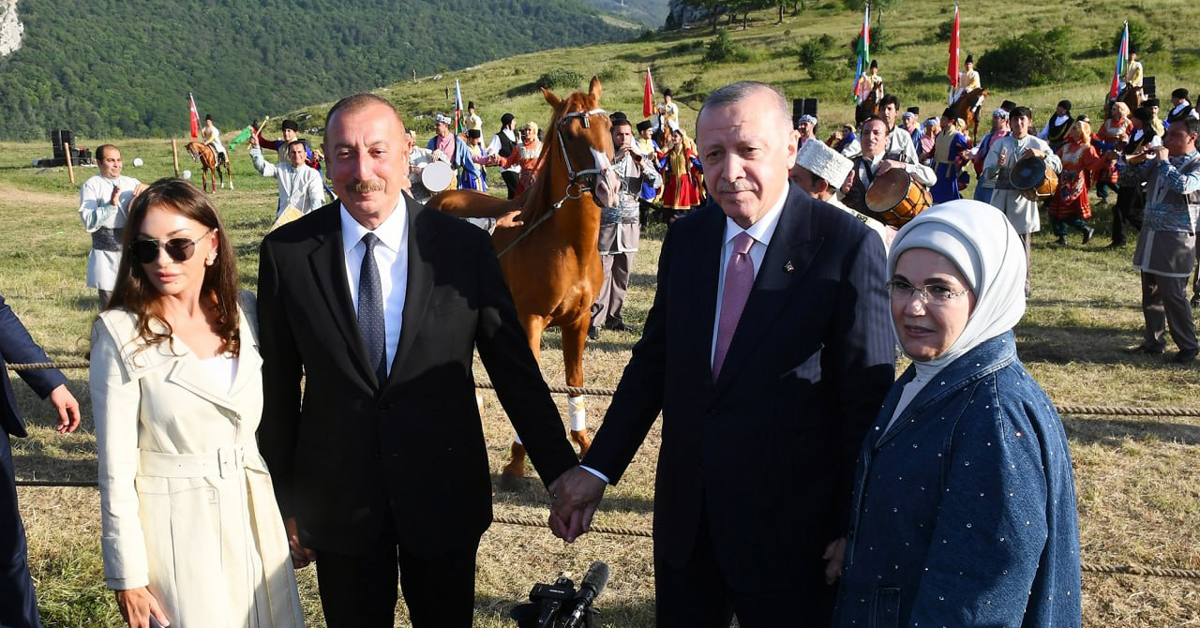
On June 15, 2021, the presidents of Turkey and Azerbaijan signed the “Shushi Declaration on allied relations between the Republic of Azerbaijan and the Republic of Turkey.” Following the signing of the declaration, the presidents held a joint press conference. Emphasizing regional cooperation for the sake of peace, Erdogan voiced the Turkish side’s proposal to establish a six-party platform aimed at ensuring peace in the region. For his part, Aliyev highlighted two provisions of the declaration that concern mutual military assistance and the “Zangezur corridor.” The President of Azerbaijan most likely referred to the following paragraph of the declaration.
If, in the opinion of one of the parties, there is a threat to its independence, sovereignty, territorial integrity, inviolability of internationally recognized borders or security or aggression from a third state or states, then the parties will hold joint consultations and, in order to eliminate this threat or aggression, will take an appropriate initiative in accordance with the purposes and principles of the UN Charter, will provide the necessary assistance to each other in accordance with the UN Charter. The scope and form of this support will be determined through immediate discussions, and a decision will be made on meeting defense needs for joint activities, coordinated activities of the armed forces will be organized.
Since February 28, 2026, Israel and the United States have launched large-scale military operations against Iran. Iran, in turn, has been carrying out retaliatory strikes against American and Israeli bases located in countries across the region. The United States also maintains a military presence in Turkey; however, Ankara’s seemingly neutral posture suggests that it has not provided its territory for attacks against Iran and is unlikely to do so in the near future. The most probable reason lies in the potential consequences of being drawn into a war against Iran—particularly the possible activation of the Kurdish movement in the event of Iran’s collapse and the advancement of the process of establishing a Kurdish state, including at the expense of Turkish territories.
This is precisely why the Turkish side repeatedly emphasizes that it is not participating in operations against Iran, swiftly denies reports about Iranian missiles falling on its territory, and describes those intercepted as “accidentally diverted.” However, Israel may cleverly employ its key ally, Azerbaijan, in order to draw Turkey into a war against Iran.
On March 5, Azerbaijani media and official sources claimed that Iranian drones had struck Nakhijevan Airport and nearby infrastructure, leaving several people injured. Iran promptly denied any involvement, yet Azerbaijan continued to insist on the accusations at the highest level, even describing the attack as terrorist in nature. Baku demanded that the Iranian armed forces apologize for the incident and that those responsible be punished. Moreover, according to reports, Baku has deployed armed forces along its border with Iran.
Despite Aliyev’s assurances that Azerbaijan is not participating in military operations against Iran, various Iranian military and political officials have issued warnings addressed to Baku. In particular, President Masoud Pezeshkian stated that Iran does not seek confrontation with its neighbors; however, it will respond very harshly to any country that supports an attack against it. Iran’s Ministry of Foreign Affairs also issued a statement of similar content, emphasizing that the Iranian armed forces are targeting only the American and Israeli military presence, and not neighboring countries.
On March 8, 2026, Tehran issued a direct warning to Baku to prevent the spread of instability in the region. The spokesperson of the General Staff of Iran’s armed forces called on Baku to expel the Zionists from Azerbaijan. It was also noted that, despite the aggression undertaken by the United States and Israel in the region, Iran’s armed forces have made maximum efforts not to harm the national security and interests of friendly, neighboring, and Muslim countries.
This targeted statement already suggests that, regardless of whether the strikes in the direction of Nakhijevan were indeed carried out by Tehran or not, Iran is well aware of Azerbaijan’s participation in actions conducted against it. Accordingly, if the drone attack against Nakhijevan was in fact organized by the Iranian military, it could be interpreted as a warning. Although Iran’s president, during a phone conversation with Aliyev, also denied Iranian involvement in the drone strike against Nakhijevan, Baku is nevertheless exploiting the incident, also against Turkey.
Contacts between Baku and Ankara following the reported drone strikes in Nakhijevan also suggest that Azerbaijan is attempting to amplify the significance of the incident. Ankara, in essence, may be wary that Baku—yielding to Israeli intentions—could invoke the Shushi Declaration in order to demand the necessary support from Turkey. Through this astute move, two of Israel’s adversaries—Turkey and Iran—could end up fighting each other, with Azerbaijan acting as the catalyst.
Judging from the developments following the Nakhijevan drone incident and the continued accusations by Baku toward Iran, it is evident that Azerbaijan is escalating the anti-Iranian narrative. Iran is well aware of Israeli operations against it carried out from Azerbaijani territory, and it is therefore no coincidence that Tehran has issued a firm demand to “expel the Zionists from the territory of Azerbaijan.”
It is assumed that Azerbaijan, either at Israel’s instigation or perhaps out of its own interests, will continue to provoke Iran into striking its territory. As a result, Turkey could be drawn into the conflict through the application of the Shushi Declaration. Otherwise, Turkey risks losing credibility, with consequences that could be equally dangerous for itself. Erdoğan’s 2021 signature in Shushi has become a ticking time bomb for Turkey, with “brotherly” Azerbaijan having laid the trap and capable of triggering it at any moment.