
“GEGHARD”
SCIENTIFIC ANALYTICAL
FOUNDATION


2026
2026
2026-02-23
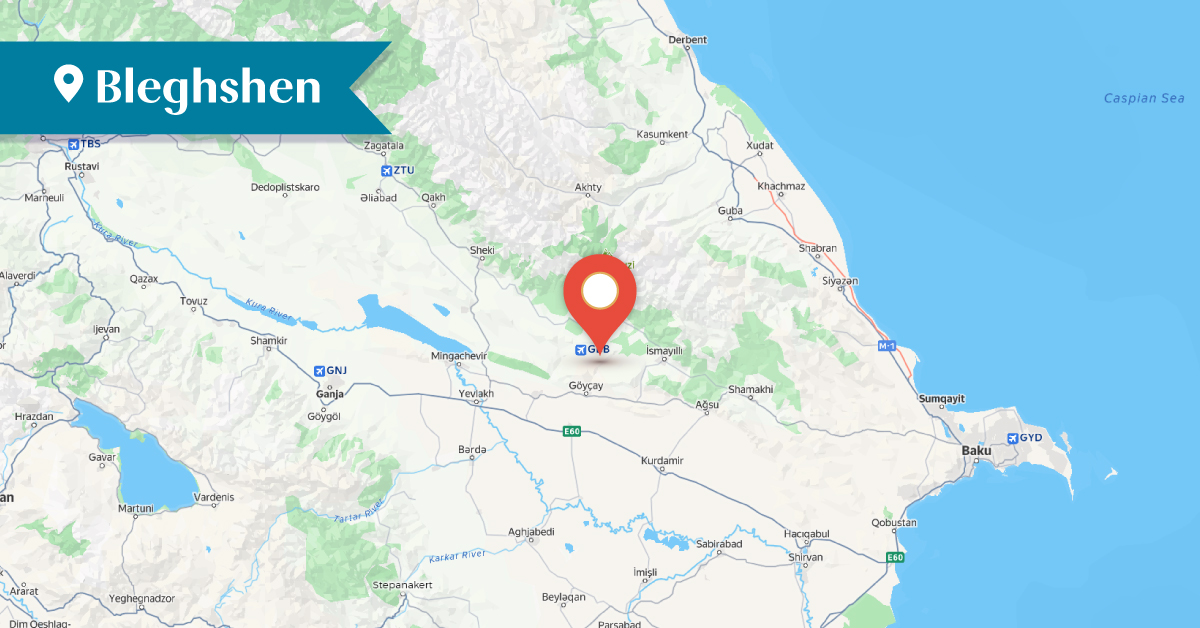
The Armenian village of Bleghshen was located in the Kapaghak district of historical Caucasian Albania, about 24 km southeast of the present-day administrative centre of Gabala (Kutkashen), near the Armenian villages of Amuravan and Beklarkyand. In various sources, the village is also mentioned as Bilegh, Biligh, Blegh. The village’s population settled here in the late 18th century, coming from the Varanda and Khachen districts of Artsakh.
In 1841, Bleghshen had 202 Armenian inhabitants; in 1851, 264; in 1876, 244. In 1889, the village had 301 inhabitants; in 1901, 236; in 1905, 287; and in 1914, 264 Armenian residents.
In 1918, the Transcaucasian Turks, together with Ottoman forces, devastated most of the Armenian settlements of the region and killed the Armenian population. The inhabitants of the village of Bleghshen also suffered this fate.
There was an Armenian school in the village. According to a record from 1895, children from the neighboring Armenian villages of Amuravan and Beklarkyand also studied at the Bleghshen school.
Bleghshen also had a church named Surb Minas, which was built in the early 19th century. Over different periods, the village was served by the following priests: Sargis Matteosyan (served from 1832 to 1851), Margar Ter-Sargsyants (served until 1860), Harutyun Hakobyan Harutyunyants (from the 1860s until 1870), Harutyun Ter-Hovhannisyan–Ter-Avagyants, Harutyun Grigoryan–Ter-Davtyants (1873 to the 1890s), and Nerses Voskanyants (1910–1917).
In 1984, when the monument specialist Samvel Karapetyan visited the former site of the village, no traces of the church were visible in Bleghshen. In the area of the village cemetery, Karapetyan discovered about 30 preserved tombstones dating to the 19th–20th centuries. Some of these bore Armenian inscriptions.
For example: “Here lies Hayrapet Ter Sargisean from Bleghshen, who passed away in 1857,” or: “Here rests the body of the priest Margar Ter Sargisean form Bleghshen. Whoever see this, ask (God) for mercy. 1860.”
Other tombstones bear inscriptions such as: “Here lies the Grigor Ghahramanean Ohanyants from Bleghshen, 1872,” or: “In this grave rests Khachatur Harutyunian, who passed away in 1874, on September 15, in the village of Blegh,” or: “This is the grave of the priest Harutyun Grigorean Davityants form Biligh, born in 1830, died in 1898, November 15. May God have mercy.”
At present, near the former settlement of Bleghshen, there is a village of the same name (Azerbaijani: Bılıx), which was founded in the late 20th century.
Bibliography
Barkhutaryants, M. The Land of Aghvank and Its Neighbors. Artsakh. Yerevan, 1999, p․ 113.
Blegh, Nor-Dar, 1888, no. 212, December 16, p. 2.
Khoi-Zadeh, Nukhi, Nor-Dar, 1895, no. 223, December 19, p. 2.
Karapetyan, S. Armenian Inscriptions of Proper Aghvank, Book I. Yerevan: NAS RA “Gitutyun” Publishing House, 1997, p․ 38
Karapetyan, S. Aghvank Proper, Research on Armenian Architecture Foundation, 2024, Book 22, Part 1, pp. 250-252.
Mshak, 1882, no. 89, May 22, p. 2.
Syunetsi, Amirvan, Nor Dar, 1887, no. 86, June 3, p. 2.