
“GEGHARD”
SCIENTIFIC ANALYTICAL
FOUNDATION


2026
2026
2025-12-29
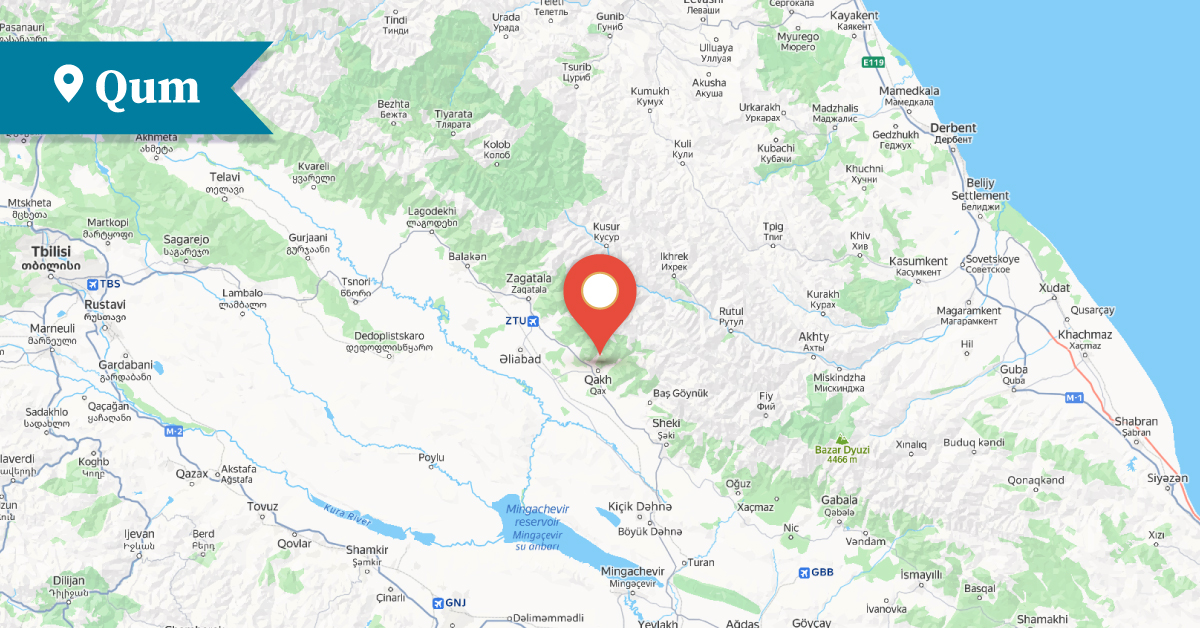
The village of Qum in the Qakh district of Eastern Transcaucasia is located 4 km north of the Qakh district center. In the late Middle Ages, the Armenian population of the village was forcibly converted to Islam. For this reason, Makar Barkhutaryants notes in his work that at the end of the 19th century the village of Qum had 446 households inhabited by a Muslim population of Armenian origin.
In subsequent years, in 1908, only 1,309 Tsakhurs (a Lezgian-speaking Caucasian people) inhabitants were recorded in this settlement, while in 1914 there were 1,255 Ingiloys (Georgians or Armenians who had adopted Islam).
By the beginning of the 20th century the Armenian population of Qum had already completely lost its national identity and become detached from its ethnic roots, assimilating with other ethnic and religious groups.
In Qum, a semi-ruined basilica church has been preserved. According to a Georgian chronicle dated to 1310, the church was called Holy Mother of God (Surb Astvatsatsin). No inscriptions have survived on the walls of the church. Specialists date the construction of the church to the 6th or 7th century.
At present, the village is inhabited by Tsakhurs.
Bibliography
Bishop Makar Barkhutaryants. The Land of Aghvank and Its Neighbors. Artsakh. Yerevan, 1999, pp. 139, 148
Karapetyan, S., Aghvank Proper, Part 1, Yerevan, 2024, pp. 230-233.
Jakobson, A. L. Architectural Connections between Caucasian Albania and Armenia.” Historical-Philological Journal, no. 1, 1977, pp. 69–84.