
“GEGHARD”
SCIENTIFIC ANALYTICAL
FOUNDATION


2026
2026
2024-10-21
On October 26, 2024, parliamentary elections will be held in Georgia. The country's president officially announced the start of the campaign on August 27. The ruling Georgian Dream party has stated that it wants to form a constitutional majority and remove from the political field the largest opposition force, the "United National Movement" party, and other political forces allied with it. Some opposition parties, setting aside their differences, have presented unified lists, while others are contesting the parliamentary elections independently.
In 2020, one of the pre-election messages of the ruling Georgian Dream party was 'David Gareji is Georgia.' At the time, the party accused the previous government of ceding Georgian territory to Azerbaijan, including the historic David Gareji monastery complex. A few weeks before the 2020 parliamentary elections, on October 7, cartographers Iveri Melashvili and Natalia Ilichyova were arrested[1]. Although the Tbilisi City Court later released them on bail, the case remains open. The Georgian government emphasized that this criminal case was of national significance.
On September 5, 2024, the opposition newspaper Batumelebi published an interview with Iveri Melashvili, the former head of the expert group of the Georgian-Azerbaijani intergovernmental commission on delimitation and demarcation of the state border, who is a defendant in an ongoing criminal case. In the interview, Melashvili stated that 'in 2020, the mention of David Gareji was simply a lie and propaganda.' The newspaper highlighted that during the current campaign, the ruling party has not mentioned the topic of Gareji at all, questioning whether 'Gareji is no longer Georgia'.
Melashvili also emphasized that 'after the 2020 elections, nothing changed in that regard. On the contrary, the campaign angered our neighbor and partner, Azerbaijan. Previously, our pilgrims and tourists could pass the mountains and enter the monastery cells, but now they are not allowed.' He added that in 2014-2015, the issue with the map had been discussed: "We all explained, and they stopped discussing this topic, but before the elections they raised it again to deceive the public." When asked by a journalist why "Dream" no longer mentions the topic of David Gareji, Malashvili replied: "They can no longer deceive people with the same statements... By the way, during the 2020 elections, the "Cartographers' Case" hurt "Dream" more than it helped."
On September 14, Bidzina Ivanishvili, the founder of the Georgian Dream, the honorary chairman of the party, and a billionaire, during one of the campaign rallies, stated that "after the elections, we need to find the strength and apologize for the fact that, according to the received instruction, the traitorous National Movement' in 2008 fired at our Ossetian sisters and brothers." Ivanishvili has also repeatedly stated that "to prepare for the restoration of territorial integrity," it is necessary to form a constitutional majority, and this restoration is possible only by peaceful means.
Following similar statements by Ivanishvili, Georgian experts and politicians have begun drawing parallels between the 2020 and 2024 election campaigns. In 2020, the focus was on territorial integrity, with the campaign centered around the issue of David Gareji and its ownership. In 2024, however, the emphasis has shifted to Abkhazia and South Ossetia.
Georgia's former Prime Minister, Giorgi Gakharia, whose party is participating in the election, recently spoke about Georgian Dream, mentioning that the “David Gareji is Georgia' campaign from 2020 and the current campaign are a bluff designed to win votes. Gakharia stated, 'Why do I think this is dangerous for the country? Because I remember very well—and it is unfortunate that I was a part of it—what happened during the David Gareji campaign. The only outcome of that campaign was the construction of a large military base just 500 meters from David Gareji”.
It is worth noting that in recent years, there have been no significant developments regarding the ownership of the David Gareji monastery complex. Since the 2020 parliamentary elections, the topic has largely disappeared from Georgia's political and media landscape. According to Azerbaijani statements, two-thirds of the 480-kilometer Georgian-Azerbaijani border has been agreed upon. The Azerbaijani side asserts that there are no disputed issues along the border, only unresolved matters.
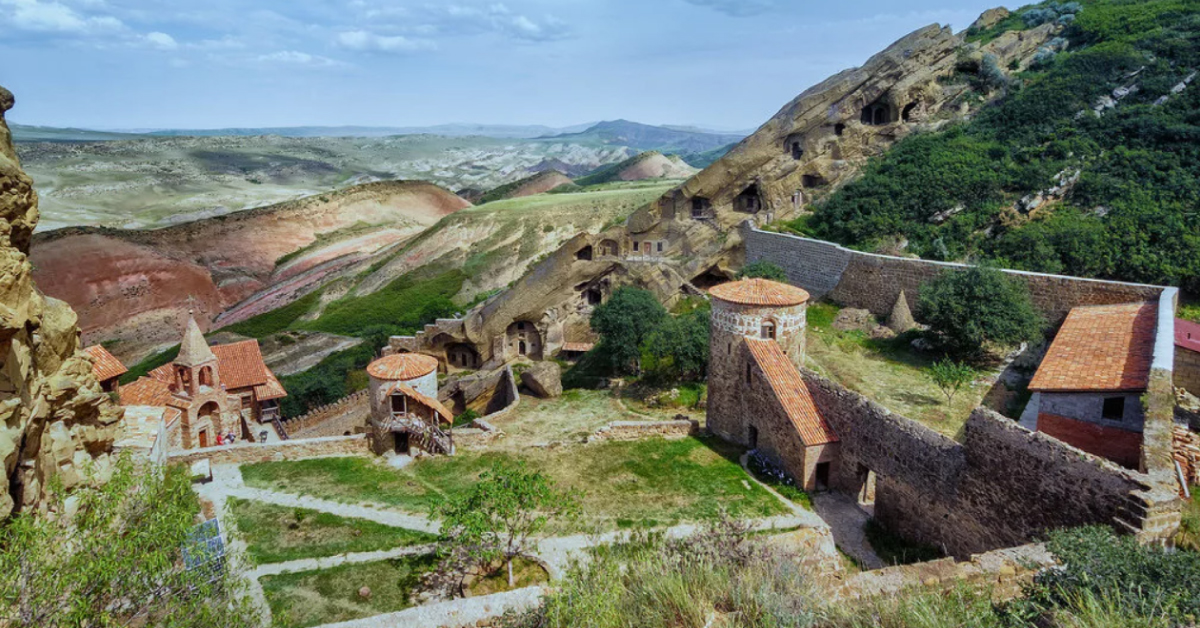
The David Gareji monastery complex is unique, consisting of about 20 monasteries scattered on both sides of the mountain range that crosses the Georgian-Azerbaijani border. The main monastery of the complex is the Church of Saint David, which is now on the Georgian side. On the other side of the mountain range are the churches of Udabno, Chichkhituri, and Bertubani, which are currently under Azerbaijani control. Azerbaijan claims that the churches are the heritage of Caucasian Albania and have no connection to Georgia. It should be noted that this section of the border is of strategic importance for Azerbaijan, as evidenced by the military base and infrastructure development in that area. It is also evident that Georgian government is not showing much activity on the Gareji issue, due to economic, political, and military cooperation with Azerbaijan and other issues.
[1] The cartographers were accused of concealing maps crucial to Georgia during border delimitation and demarcation negotiations with Azerbaijan. Specifically, they were alleged to have hidden the original 1:200000 scale maps printed in 1937-38, forcing the Georgian commission to rely on less detailed 1:100000 and 1:50000 scale maps from the 1970s and 1980s.