
“GEGHARD”
SCIENTIFIC ANALYTICAL
FOUNDATION


2026
2026
2026-10-07
In recent days, reports have become widespread in Azerbaijan of students wearing hijab being removed from schools, barred from attending classes, and being instructed to stop wearing headscarves. In particular, a video has been posted on Azerbaijani and international social media showing hijab-wearing female students being denied entry to secondary school No. 6 in the city of Sumgait.
Similar incidents have occurred at the secondary school in the village of Yolchubeyli in Sabirabad district and at secondary school No. 24 in Ganja. According to reports, on September 30, the principal of the Yolchubeyli secondary school, Kenan Alasgarli, warned female students: “Either take off your headscarves next week, or leave the school.” According to the parents, the principal received the instruction from the Ministry of Education and Science.
These developments come against the backdrop of the decision adopted by the Azerbaijani government on September 21 concerning amendments to the requirements for students’ clothing in state general education institutions. According to the document, the use of clothing items that do not adhere to the uniformity of the prescribed school uniform or do not comply with the principles of the secular nature of general education is not permitted. The decision does not use the word “hijab” and does not specifically refer to any religious clothing. Nevertheless, religious activists have interpreted the amendment as a ban on headscarves that are not part of the school uniform. The document also does not specify which particular items of clothing are considered incompatible with the principle of secularism.
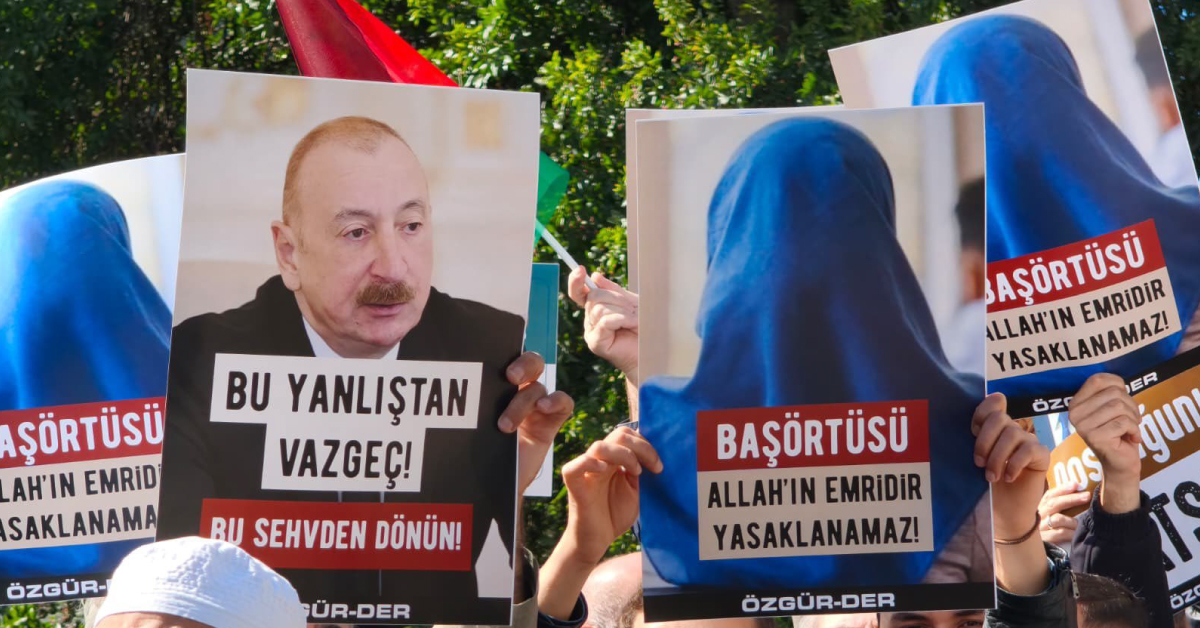
The discussions have also spilled over into Turkey, where religious figures have criticized the Azerbaijani government and even issued threats. On October 3, Turkish activists staged a protest outside the Azerbaijani Consulate in Istanbul, organized by the Association for Freedom of Thought and the Right to Education, to protest restrictions on wearing the hijab in Azerbaijani schools.
A few days earlier, the issue of the hijab had already become a major topic of discussion on Azerbaijani social media, and tensions escalated further following the arrest of theologian Abgul Suleimanov. He was detained on the evening of September 22 and subsequently sentenced by a court to 30 days of administrative detention. Suleimanov had spoken out against restrictions on schoolchildren wearing the hijab. His family has linked the detention directly to his stance on the issue.
In early April there have already been complaints about hijab-wearing female students being denied access to schools, when girls wearing the hijab were barred from attending secondary school No. 15 in Sumgait.
“The school expelled a student who was under 18, depriving her of the opportunity to continue her education,” the girl’s parent said. “Under Article 42 of the Constitution, we have the right to education. Yet because of our religious beliefs, our children and grandchildren are being prevented from attending school, while the school administration has refused to provide an official notice explaining the decision to remove my daughter from classes.” According to the parent, the student was told either to remove her headscarf or to take it off when arriving at school, attend her classes, and put it back on afterward. The parent said they had also contacted the Regional Education Department, which responded that the matter was an internal decision of the school.
Reports that hijab-wearing students were being denied entry to schools had already emerged in March. According to reports, Afat Jamalova, the principal of secondary school No. 3 in the village of Mehdiabad, had expelled 23 students for wearing hijab. In early March, a similar incident was reported at secondary school No. 1 in the village of Gizilaghaj, where the principal expelled three students for wearing the hijab.
According to Arzu Abdulla, an activist who advocates for religious freedoms in Azerbaijan, wearing the hijab has been banned since early March at secondary school No. 261 in Baku’s Khatai district, secondary schools No. 3 and No. 4 in Mehdiabad, and secondary schools No. 15 and No. 17 in Sumgait. The activist told OC Media that on March 15, two more female teachers wearing the hijab were dismissed from secondary school No. 17 in Sumgait, further increasing the number of people affected by the restrictions. In her view, “in the near future, the hijab ban will be officially legal.”
In an interview with the Azerbaijani service of Radio Free Europe/Radio Liberty, Fidan Maherramova, a resident of Beylagan, said that the principal of a local secondary school had warned her eighth-grade daughter not to attend school wearing a hijab. When the parent asked why, the principal reportedly emphasized that it was an “order from above.”
Vusal Hasanli, a resident of the Imishli district, wrote on his Facebook page that his two daughters had been removed from classes because of the ban on wearing the hijab at school No. 3. Moreover, the school principal reportedly warned that if the girls did not remove their hijabs, they would be barred from attending school altogether.
According to videos and reports circulating online, Rena Guliyeva, the principal of secondary school No. 8 in the Imishli district, has barred students from entering the school wearing headscarves. A similar situation has reportedly occurred at secondary school No. 7 in Jalilabad.
Against this backdrop, reports appeared on Azerbaijani social media and several news pages claiming that “the hijab would also be banned in other state institutions, while the wearing of the traditional national headscarf, the kelaghai, would be encouraged instead.”
Publications citing the Azerbaijani media outlet Yeni Musavat reported that Azerbaijan was planning to restrict the wearing of religious head coverings, including the hijab, in schools, universities, and state institutions. However, the original article was subsequently removed. Rauf Arifoglu, head of the Yeni Musavat media group, later officially denied the report, stating that no such decision had been made or discussed at the state level and that the article had been published based on unverified information.
Previous incidents and protests over hijab restrictions
The issue of restrictions on wearing the hijab in Azerbaijani schools is not new. In 2010, Education Minister Misir Mardanov announced that all students were required to wear the prescribed school uniform, effectively ruling out the wearing of the hijab. Hundreds of adults and children took part in a protest against the decision. The protesters argued that the restriction violated their religious beliefs. Sixteen participants were detained during the protest.
Protests against the hijab restrictions continued in Azerbaijan in late December 2010. In Ganja, police dispersed a demonstration held near the Shah Abbas Mosque and detained dozens of participants. Similar protests were also held in the Nardaran settlement near Baku, as well as in the Masalli and Astara districts.
Protests against the hijab restrictions continued in 2011, accompanied by further arrests. On May 6, several protesters were detained following clashes between demonstrators and police outside the Ministry of Education in Baku. Among those taking part were religious figures who chanted slogans such as “Freedom for the Hijab” and “Allahu Akbar” and held posters reading, “Hijab is a constitutional right of schoolgirls.” They called to lift the ban on wearing hijab in secondary schools and higher education institutions, arguing that it violated constitutional rights.
Another protest under the slogan “Freedom for Hijab” was held in Baku in October 2012. More than 65 protesters were detained, while 20 police officers were reportedly injured. Those detained were referred to as “hijab prisoners.” It should be noted that following the mass protests, the decision restricting the wearing of the hijab in Azerbaijan was eventually revoked.
Although Shia Muslims make up the majority of Azerbaijan’s population, the authorities have repeatedly imposed restrictions on prominent or outspoken religious believers. In August 2025, six women were arrested on charges of “holding a protest under the guise of religious ceremonies” while distributing charity in Baku’s Khazar district on the occasion of a Shia commemorative day. Videos of the incident, showing police using force against the women, were widely circulated on social media.
It is noteworthy that Article 42 of Azerbaijan’s Constitution guarantees everyone’s right to education and establishes the state’s obligation to provide free and compulsory general secondary education. At the same time, Article 48 of the Constitution guarantees freedom of conscience, stipulating that “no one shall be forced to express (or demonstrate) his or her religious faith and belief, to execute religious rituals or participate in religious ceremonies.”
The issue of wearing hijab in Azerbaijani schools and other educational institutions has been a source of social and political tension for years, repeatedly returning to the public agenda. Although the authorities justify these restrictions on the grounds of preserving the country’s secular character and maintaining uniform rules within the education system, they often come into conflict with the fundamental rights of citizens—particularly women and girls—to education and freedom of conscience and religion. The new rules adopted by the Azerbaijani authorities do not explicitly ban the hijab however, active measures are being taken to enforce a de facto ban. Given the pressure on religious women in the country, it cannot be ruled out that these measures are also intended to gauge public reaction and lay the groundwork for formally legalizing restrictions on hijab itself at a later stage.