
“GEGHARD”
SCIENTIFIC ANALYTICAL
FOUNDATION


2026
2026
2026-08-31
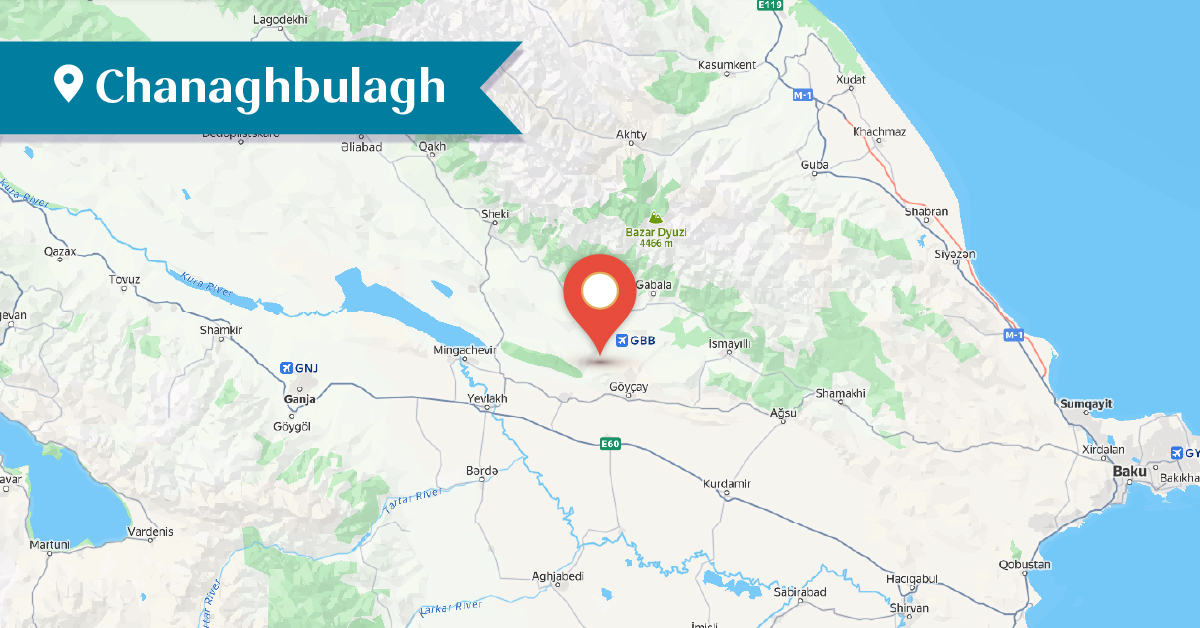
The village of Chanaghbulagh in the Kutkashen district was located approximately 27 km southwest of the district center, Kutkashen (present-day Gabala).
Chanaghbulagh was one of the old Armenian-populated settlements in the area. It is not known exactly from which century Armenians had lived there. However, by the 18th century, the village had already been deserted. An old Armenian cemetery dating to that period has been preserved in Chanaghbulagh. At the beginning of the 19th century, Chanaghbulagh was resettled by Armenians who had moved from the Khachen, Jraberd, and Varanda districts of Artsakh.
According to data from 1841, the village had a population of 155. By 1851, the number of Armenian inhabitants of Chanaghbulagh had reached 376. As a result of population growth, 473 Armenians were living in the village in 1853. The Armenian population of Chanaghbulagh reached 519 in 1876 and 696 in 1889. According to data from 1901, 818 Armenians lived in Chanaghbulagh; in 1908, 873; in 1914, 903; and in 1918, 960 Armenians.
The village was home to the Church of Saint Astvatsatsin (Holy Mother of God), where the following clergymen served: Rev. Nerses Danielyan (1822–1857), Nerses Ter-Simonyan-Kolyants (mentioned in 1868), Hakob Hovhannisyan-Kolyants (1873–1880), and Astvatsatur Arustamyan-Arushanyan (who served until 1912).
In the 1870s, the village also hat an Armenian school. A record has been preserved mentioning the school's teacher, Father Hakob Hovhannisyan-Kolyants.
The village’s population suffered during the Armenian–Tatar clashes of 1905–1907. In 1905, Caucasian Tatars attacked the village and looted the livestock belonging to Armenian peasants.
Like the Armenian population of all Armenian villages in Eastern Transcaucasia, the Armenians of Chanaghbulagh also suffered during the events of 1918, when Ottoman forces that had entered the region, together with local Caucasian Tatar forces, destroyed Armenian settlements. Following these events, the Armenian village of Chanaghbulagh in Eastern Transcaucasia ceased to exist.
Literature
Barkhutareants, M. The Land of Aghvank and Its Neighbors. Artsakh, Yerevan, 1999, p. 112․
Karapetyan, S. Aghvank Proper. The Research on Armenian Architecture (RAA) Foundation, 2024, Vol. XXII, Part 1, pp. 311-312.
Ter-Yakobyeants, Gr., “Nukhi,” Meghu Hayastani, 1880, No. 94, December 6, p. 3.
Alphabetical Lists of Armenian Gregorian Churches and Muslim Mosques in the Empire. Department of Ecclesiastical Affairs of Foreign Religions, 1886, pp. 70–71.
Caucasian Calendar for 1910. Tiflis, 1909, p. 410.
Caucasian Calendar for 1915. Tiflis, 1914, p. 204.