
“GEGHARD”
SCIENTIFIC ANALYTICAL
FOUNDATION


2026
2026
2026-06-12
“A feminine character has formed in Azerbaijani boys; they are losing their masculinity.”
— Deputy Chairman of the “Western Azerbaijan” Community
The scholarly and analytical community usually steers clear of political-propaganda structures such as the “Western Azerbaijan Community” (Qərbi Azərbaycan İcması). The project is viewed as an instrument of propaganda, a tool of hybrid warfare, a manifestation of irredentism: far too much ideological noise, far too little academic integrity. Perhaps that is precisely what makes it convenient.
This concerns a so-called “civic” organization that deals with the affairs of the Azerbaijanis who left Armenia in the late 1980s. The “Western Azerbaijan Community” increasingly resembles a closed club embedded in the political architecture of President Ilham Aliyev’s administration, and in essence it performs two main functions.
Firstly, it creates and feeds the myth of “Western Azerbaijan” — that is, a fabricated name for Armenia, presented as a future territory of “return.” Secondly, this artificially circulated topic secures a financial resource for the project’s leadership.
In other words, a project built on falsified historical memory and the slogans of the “return” theme simultaneously becomes a convenient platform for enriching people of dubious reputation. The leadership includes former officials, university rectors, and figures mired in corruption scandals, diploma forgery, business dealings, tenders, and administrative abuses.
The formula is almost perfect: for society, a fabricated myth and a false dream; for the administration, an instrument of hybrid warfare; for the project’s participants, unmonitored and unaccountable access to public funds.
Financial Infrastructure: the Hidden Part of the Iceberg
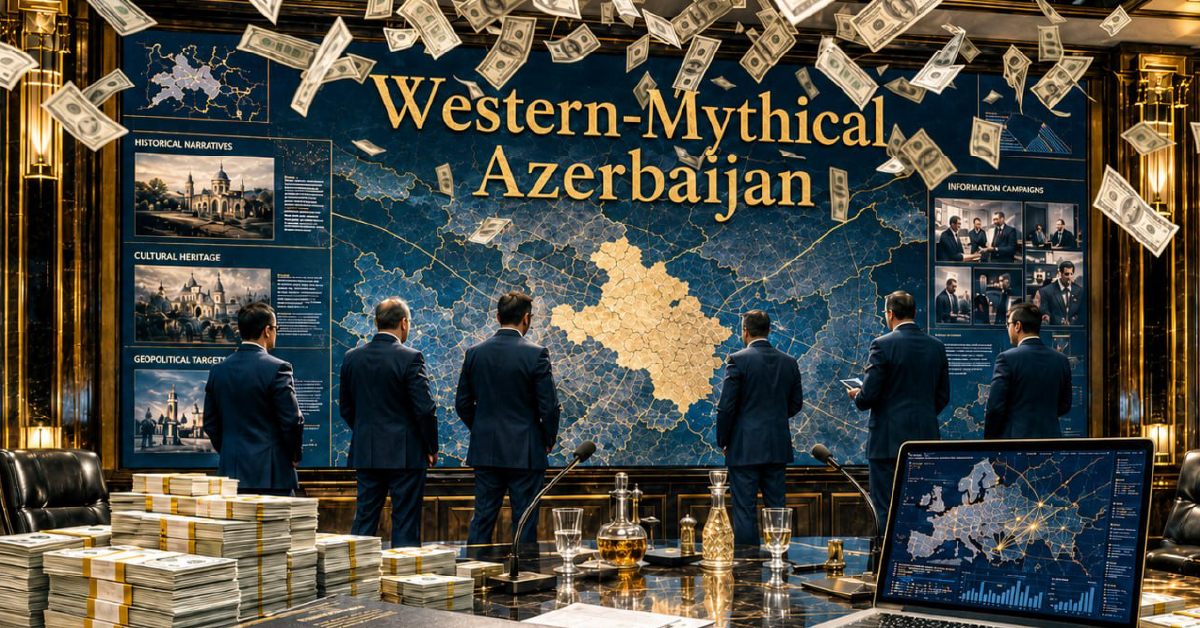
Leaked documents attest that the organization’s activities are closely and directly tied to Azerbaijan’s state structures. Important data was published by OC Media on November 3, 2025. An investigation based on the leak of internal documents establishes that President Aliyev’s administration coordinates and finances the promotion of the “Western Azerbaijan” narrative, while the “Western Azerbaijan Community” serves as a means of publicizing the project.
According to the published documents and contracts, on a single international conference alone (“Ensuring the Safe and Dignified Return of Azerbaijanis Expelled from Armenia: Global Context and Just Solution,” Baku, December 5–6, 2023) more than $65,000 (around 109,000 manats) was spent from state funds. In another data leak, in 2025 four contracts worth roughly $56,000 (95,000 manats) came to light.
These instances of data leakage show what enormous resources the project commands. If tens of thousands of dollars are spent on individual events, one can only imagine the size of the overall budget.
It is important to emphasize: there is no open data containing annual budgets, financial reports, or a list of state contracts. The numbers that have surfaced do not reflect the total sum spent on the entire information campaign. They show only the portion that became known thanks to leaks and journalistic investigations.
The Organization’s Origins and Its Institutional Relaunch
The “Western Azerbaijan Community” declared itself the legal successor of the “Azerbaijan Refugee Society,” which had operated since 1989. On August 3, 2022, the name was changed, a new charter was approved, and the structure received an expanded institutional packaging: a general assembly, boards of directors and supervisors, an audit commission, and so on.
Board of Trustees Chairman Murvat Hasanli: Business and the Shadow of Criminal Mediation
Within the leadership of the “Western Azerbaijan” project, businessman Murvat Hasanli stands out for his ties to “thieves-in-law and the criminal world.” In 2021, the press circulated details of a scandalous case involving a business project in which Hasanli took part. Later, in order to settle a business dispute with a former classmate, Murvat Hasanli turned to the thief-in-law Nadir Salifov (better known in the criminal world as Lotu Guli).
Ahliman Amiraslanov: the “Diploma Business” of the Council of Elders’ Head
The Council of Elders is the “Community’s” advisory collegial body, headed by Ahliman Amiraslanov. According to Azerbaijani press reports, during his rectorship at Azerbaijan Medical University a corruption system took shape at the institution, linked to admission exams, examination sessions, and administrative influence. According to those reports, the cost of admission to the medical faculty reached up to 100,000 manats; the other faculties had their own “tariffs” as well.
This is not sarcasm. The state-run “Western Azerbaijan” project entrusts the role of “elder” to a man whose name has been publicly associated with systemic corruption in education. Apparently, in the newly formed patriotic ethic, experience in collecting money from students is an important qualification for a leader.
Supervisory Board: Misir Mardanov and the Years of Fake-Diploma Sales
The Supervisory Board is headed by Misir Mardanov, Azerbaijan’s Minister of Education from 1998 to 2013. As the Azerbaijani expert Etibar Aliyev aptly noted, bribery in the sector encompassed every level of the system — from kindergartens to universities. In 2019, the dismissal of about 2,500 teachers holding fake diplomas from schools caused a major uproar. It is no accident that Mardanov is considered one of the former officials whose name is directly linked to corruption.
Council of Intellectuals: Diplomas, Plagiarism, and the Pedagogy of “Masculine Character”
The Council of Intellectuals was presumably meant to be the project’s most authoritative component, yet its personnel makeup compels one to view it as an “Azerbaijani museum” of post-Soviet bureaucracy.
The council is chaired by Elkhan Huseynov, former rector of Sumgait State University and Azerbaijan’s ambassador to Turkmenistan. On September 13, 2023, he was dismissed from the post of rector. Why? Public discontent had grown around Huseynov’s activities; he was accused of bribery and corruption, as well as of dismissing the university’s long-serving lecturers and hiring his own associates, which had created internal tension at the institution. Ultimately, after numerous complaints and public discussions, he was removed from office.
Nizami Jafarov is one of the deputy chairmen of the “Council of Intellectuals” of the “Western Azerbaijan” community — a doctor of sciences and professor. The representative of “Western Azerbaijan’s” intelligentsia became an object of ridicule over plagiarism. The 2018 dispute with academician Kamal Abdulla over an “Etymological Dictionary” was scandalous, and in its course the plagiarism committed by Jafarov was exposed. His literary and political commentaries also frequently became topics of discussion in the press and public circles.
Deputy Chairman Farrukh Rustamov — a doctor of sciences and professor — became known for his masterclass in sexism. The press attributes to him the view that the small number of male teachers leads to “feminization,” and to the formation of a “feminine character” in Azerbaijani boys. According to Rustamov’s sensational statement, the rising number of divorces in Azerbaijan is due to the fact that masculinity has not formed in men: a boy raised from infancy surrounded by women, upon becoming the head of a family, is unable to manage it and ultimately divorces.
Such is the intellectual face of the “Western Azerbaijan” project: an “authoritative” former rector, a professor-plagiarist, a doctor of sciences who explains social problems through the “feminization” of boys. The lineup is, no doubt, impressive — especially if the goal is not to study the past but to school the present.
Women’s Council: Family Patronage Under the Slogans of a Public Mission
The Women’s Council is headed by Malahat Hasanova, a member of parliament and of the Political Council of the “New Azerbaijan” Party. Public discussion of her name is tied not only to politics but also to the accusations leveled at the school-lyceum run by her sister. The school recorded cases of illegally collecting money from pupils and of unjustified bonuses. The case is characteristic of Azerbaijan’s post-Soviet configuration: political status, family ties, educational institutions, informal recruitment, and public denial of the problem.
In Lieu of a Conclusion: the Myth as a Tool of Business and Hybrid Warfare
It is clear that the so-called “Western Azerbaijan” has had — and could have had — no connection whatsoever to the territory of the present-day Republic of Armenia: neither as a historical-political reality, nor as a legal category, nor as a legitimate state concept. This is not a forgotten homeland or a concealed truth, but an artificially created myth equipped with multipurpose political conveniences.
The reality is that in Azerbaijan this is understood better than anywhere else. That is precisely why the myth is consistently publicized through websites, conferences, exhibitions, and “digital platforms.”
If it does not exist in reality, it is created through administrative resources and finances; if the historical basis is insufficient, it is falsified by the power of money; if there is no evidence, it is generated through conferences, the bribing of fee-receiving foreign guests, memoranda, maps, and digital platforms.
This is precisely the paradox. A state that leaves social problems unresolved for years finds the funds and political resources to service a fabricated map: for real people — unemployment, corruption, low-quality education; for the myth — fee-paying conferences, expensive hotels, information campaigns, international platforms, and “return” NGOs. There is no money for social problems — for instance, for newborn and maternity benefits — but there is money for the myth.
The selection of the “Community’s” leadership is not random but a deliberate model: a closed club of people with tarnished reputations — gurus of bribery, sellers of fake diplomas, clients of the criminal world, sexists… Everything fits: such a structure could hardly have been composed of the pious.
“Western Azerbaijan” is not a historical concept but a tool of hybrid warfare. It distorts historical memory, covertly shapes territorial claims, and attempts to mobilize society around the idea of a fabricated “lost homeland.”
The issue is not even whether anyone believes the “Western Azerbaijan” thesis, but rather who benefits from making Azerbaijani society pretend to believe it.
The “Western Azerbaijan” project exists not in history, law, and geography, but in the offices of the Azerbaijani authorities, where myths are turned into budgets, and budgets into weapons against Armenia.