
“GEGHARD”
SCIENTIFIC ANALYTICAL
FOUNDATION


2026
2026
2026-11-26
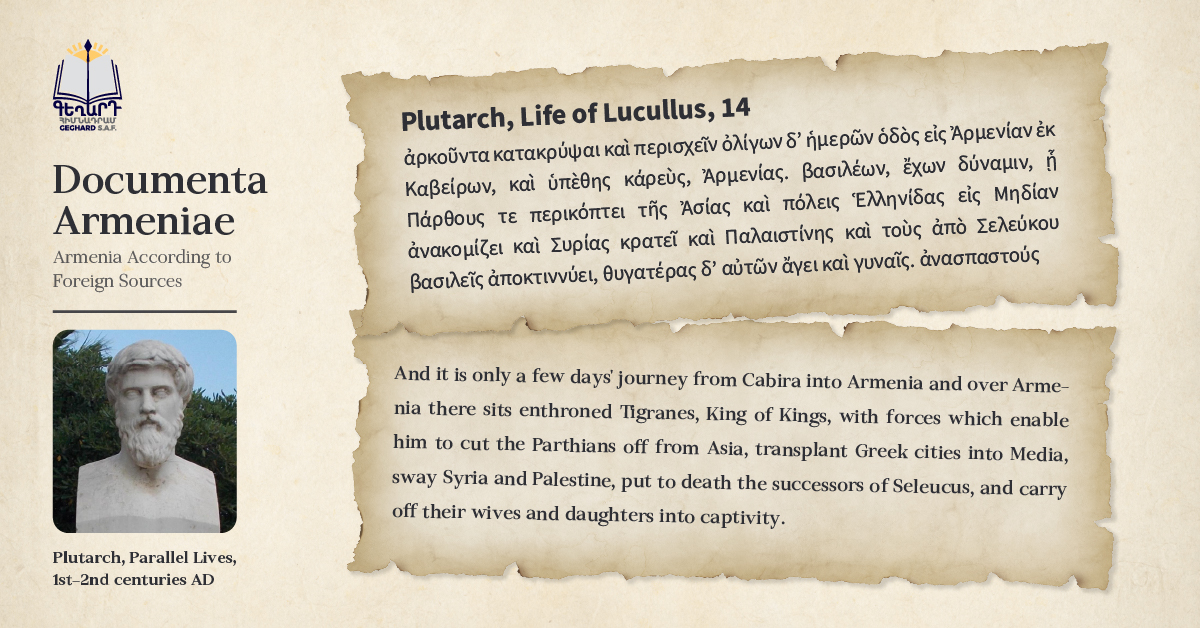
The Greek historian, biographer, and philosopher Plutarch (c. 45/50 – c. 120 AD) makes several references to the Armenians and Armenia in his work Parallel Lives. The section devoted to the Roman general Lucullus contains particularly interesting passages concerning Armenia, especially the empire of Tigranes the Great.
Thus:
“That,” he said, “is the very thing I want, and I am sitting here to get it. I want the man to become powerful again, and to get together a force with which it is worth our while to fight, in order that he may stand his ground, and not fly when we approach. Do you not see that he has a vast and trackless desert behind him? The Caucasus, too, is near, with its many hills and dells, which are sufficient to hide away in safety ten thousand kings who decline to fight. And it is only a few days' journey from Cabira into Armenia and over Armenia there sits enthroned Tigranes, King of Kings, with forces which enable him to cut the Parthians off from Asia, transplant Greek cities into Media, sway Syria and Palestine, put to death the successors of Seleucus, and carry off their wives and daughters into captivity. This king is a kinsman of Mithridates, his son-in‑law. He will not be content to receive him as a suppliant, but will make war against us. If we strive, therefore, to eject Mithridates from his kingdom, we shall run the risk of drawing Tigranes down upon us. He has long wanted an excuse for coming against us, and could not get a better one than that of being compelled to aid a man who is his kinsman and a king. Why, then, should we bring this to pass, and teach Mithridates, when he does not know it, with what allies he must carry on war against us? Why help to drive him, against his wish and as a last resource, into the arms of Tigranes, instead of giving him time to equip himself from his own resources and get fresh courage? Then we shall fight with Colchians and Tibareni and Cappadocians, whom we have often overcome, rather than with Medes and Armenians.”
Plutarch, Parallel Lives, “Lucullus,” Chapter XIV