
“GEGHARD”
SCIENTIFIC ANALYTICAL
FOUNDATION


2026
2026
2024-03-11
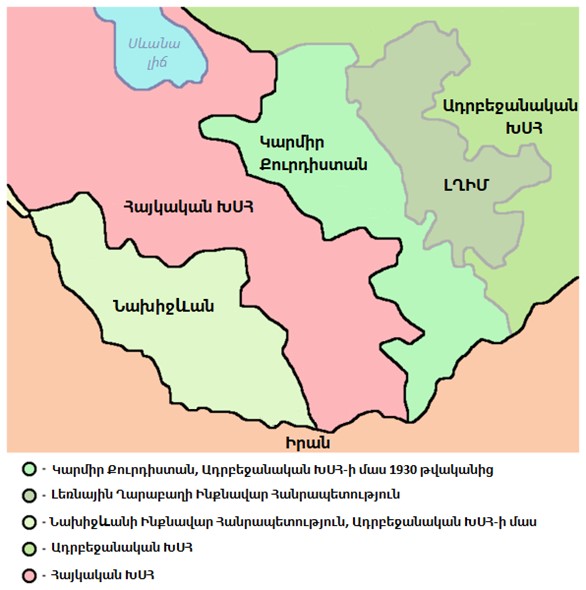
In the beginning of the 1920s, the agricultural census conducted in 1921 is of great primary importance from the point of view of studying the demography of the territory of Nagorno Karabakh (Artsakh) and the newly formed Kurdistan uezd. In Nagorno-Karabakh, the census was conducted in August 1921, immediately after the unfair decision of the July 5, 1921 session of the Caucasian Bureau plenum. After a two-year delay in applying for regional autonomy to Nagorno-Karabakh, an autonomy was created by the decree of the Central Executive Committee of Soviet Azerbaijan on July 7, 1923. However, regional autonomy was not granted to all of Nagorno Karabakh. The province of Kurdistan, which had never existed before, was separated from it. It is also interesting that in 1923-1936 the official name of the autonomous region was not “Nagorno-Karabakh Autonomous Region” («Нагорно-Карабахская автономная область»), but “Autonomous Region of Nagorno-Karabakh” («Автономная область Нагорного Карабаха») (the above-mentioned names are translated in Armenian in the same way: Nagorno Karabakh Autonomous Region), which means that the autonomy was created only on a part of Nagorno-Karabakh, while the first name limits Nagorno-Karabakh to the territory of the Autonomous Region. In 1918-1921, Nagorno-Karabakh meant not the territories on which Nagorno-Karabakh Autonomous Region was later formed but also Northern Karabakh, Karvachar, Southern Nagorno-Karabakh, up to Araks․
There is some confusion about the results of the 1921 census conducted in the territory of the future Nagorno-Karabakh, in the sense that in the bulletins summarizing the results of the census, other data were first mentioned, and then, after some clarifications, they were changed. This can also be explained by the fact that after the census was conducted, administrative-border redrawing took place. According to the agricultural census of 1921, 126,368 people were counted in the provinces of Jraberd, Khachen, Varanda, Dizak, plus the population of Shushi (the population of which by 1921 had decreased to 9,223 people with 8,894 Türks and 289 Armenians, as on March 22-26, 1920, the entire Armenian population of Shushi was massacred), the total population of Autonomous region became 135․ 591. However, since the boundaries of the administrative units were still unclear, some inaccuracies were revised in 1924․ According to that data the population of the Nagorno-Karabakh region was 129,243, of which 122,426 (94.73%) were Armenians, 6,560 (5.07%) were Türks, and 267 (0.20) were Greeks, Russians, and Kurds. As we notice, the absolute majority of the population of Nagorno-Karabakh were Armenians. According to first All-Union census in NKOR were counted 111.694 Armenians, 12. 592 were Türks, 596 were Russians, 277 - others․ Within 5 years, the number of the Armenian population has decreased, while the number of the Turkic population has doubled.
However, apart from the issue of the number of Armenian populations in Nagorno Karabakh, the distribution of the Kurdish population and the so-called Red Kurdistan is also extremely interesting. Some researchers attribute the first use of the term “Kurdistan” to 1921 as a part of Soviet Azerbaijan). On July 7, 1923, at the plenum of the Caucasian Bureau of the RK(b)K, another decision was made to create an autonomous Kurdistan, the center and borders of which were to be determined only after the adjustment of the borders of Nagorno-Karabakh. On July 16, the presidency of the Central Committee of the Communist Party of Azerbaijan made a decision to form two uezds from the Karabakh plain: “To form Kurdistan uezd from the territories populated by Kurds”. In other words, within a few days, the idea of autonomy was limited to the uezd, but even with a uezd status, Kurdistan or, as it is commonly called, Red Kurdistan played an important role in its short existence at the local and geopolitical levels. Nagorno-Karabakh should be separated from the Armenian SSR by as much territory as possible. For this very purpose, an artificial corridor of six kilometers in width was created. Later, the Kurdish intellectual Shakro Mhoyan writes of the geopolitical significance: “The creation of Kurdistan coincided with the period when the Kurdish national liberation movement was actively unfolding in Turkey, Iran, and especially in Iraq. The Kurdish national issue was discussed at almost all international meetings. ... There are letters in which the leaders of Iraqi Kurds, Mahmoud Barzanji, appeals to Lenin for help and cooperation in the fight against British imperialism. There is no need to doubt that the international importance of the Kurdish national problem played no less a role in the attention given to the Soviet Kurds”․
The territory of Kurdistan was 3432.4 km². In July 1923, as can be seen from the documents of the Boundary Commission meeting, the Kurdish districts of Javanshir, Shushi and Kubatlu were included in its composition, most distinctly the western parts of Jevanshire and the northern parts of Kubatlu․ As of 1929, it included the regions of Kelbajar, Lachin, Kubatlu, and part of the Jabraili region․
Studying the real national image of this region is rather problematic. Different researchers give different approximate numbers regarding the population of Kurdistan. The numbers 60,000 and 50,000 are often mentioned. The territory on which Kurdistan was formed was never officially named until 1923 for the simple reason that the Kurds were never the overwhelming majority here․ In addition, the province was not called a Kurdish province, which would clearly indicate that the majority of Kurds live in the province, it had a geopolitical quality, and at the same time it did not have a special status compared to other administrative units of Azerbaijan․ The province of Kurdistan consisted of six (dayra) districts: Gharaghshlagh, Kelbajar, Kubatli, Koturli, Kurd-Haji and Muradkhanli. Lachin settlement became the center of the province․
In 1924, the total population of Kurdistan was 35,219, 80.7 percent of which are Kurds, i.e. 28,422. In the first edition of the great Soviet encyclopedia, the total number of Kurdish population in Azerbaijan (not only in Kurdistan) is stated as 34,098․ However, this number does not suggest that the number of Kurdish population in Kurdistan increased, on the contrary, after the Kurdish uprising in Turkey in 1925, the government of Azerbaijan settled the Kurds who found refuge in Azerbaijan not in Kurdistan, which would be completely logical and understandable, but in Evlakh․ In another case, 181 Kurdish families formed the village Narimanabad, which was again not within the borders of Kurdistan․ However, the authorities of Soviet Azerbaijan were not at all enthusiastic about the presence of the Kurdish factor in the Kurdistan uezd or in general in the mentioned area. Therefore, the logic of the policy applied to the Kurds in the following years led to the artificial reduction of the Kurdish element, through assimilation, registration as Türks and then Azerbaijanis in the census lists. the Azerbaijani authorities encouraged the process of Türkification and then Azerbaijabization, the long-term goal of which was to later join these regions to Nagorno-Karabakh and change the latter's ethnic image.
According to the first All-Union census of 1926, the total population of Kurdistan uezd was 51.426, from which 37.128 were Kurds. The total amount of Kurds in Azerbaijan was 41.193, from which 2.649 lived in Nakhichevan Autonomous Republic․